On 2 August I ran an experiment on self-improving coding agents and got a result I liked. Three days later I ran it properly and it went away.
The setup
An agent is given a loop and one task: write a program that plays 2048 well. 2048 is the sliding-tile game: you swipe a 4×4 grid, equal tiles that collide merge into one worth double, and a new tile drops in after every swipe, usually a 2 and about one time in ten a 4. Your score is the running total of what you have merged. Each iteration the agent improves its own solver, commits, and gets re-scored: twenty iterations in the first experiment, fifteen in the replication.
The one thing I vary is a short document describing the agent’s disposition. One is cautious: take the smallest verified step, reuse what works, a solved problem is done. The other is expansive: take the move that widens what you could do next, branch when a line stops teaching you, nothing is a stopping point.
Then I score each finished solver two ways. On the games it was tuned against, and on games it has never seen: a harder tile-spawn, where the new tile is a 4 one time in four instead of one in ten, and, critically, a 5×5 board, when every game it tuned on was 4×4. The 5×5 is the one I care about: did the agent build something general, or something that merely fits.
What the first experiment said
The first version had nine conditions and one run in each, and produced a satisfying story: the expansive disposition led to solvers that generalized to the bigger board, and letting the agent rewrite its values amplified that. The best expansive run scored roughly 800,000 on 5×5, trimmed to about 720,000 by a later truncation-free re-score. Reference points there: random play about 8,000, a greedy program taking whichever move scores best now about 80,000. Board size moves those anchors a long way, because a bigger board keeps a game alive longer, and the same greedy program scores only about 4,500 on 4×4. Every reference score is quoted for the board it belongs to.
What happened with five runs per condition
The second version pre-specified the analysis, then ran twenty runs, five in each of four conditions: the two dispositions crossed with how freely the agent could rewrite its values, bounded to its three value bullets or unrestricted. A ten-run follow-up added a third level: values frozen, never self-edited.
One statistic, Cliff’s delta: a rank measure between −1 and +1, where +1 means every expansive run outscored every cautious one, −1 is the reverse, and 0 means they interleave. Which unit it is computed at is easy to get wrong; here it is the run.
| What was measured | Cliff’s delta | p |
|---|---|---|
| Score on the games it tuned against | +0.80 | 0.001 |
| Score on a harder tile-spawn it never saw | +0.60 | 0.024 |
| Score on the unseen 5×5 board | −0.05 | 0.86 |
The first two lines, over the twenty runs and not the frozen ten, are large and clean. Disposition really does shape how good the solver gets: on the 4×4 tuning games the two expansive conditions averaged roughly 78,000 to 88,000 against the cautious 53,000 to 65,000, twelve to twenty times that 4,500 anchor.
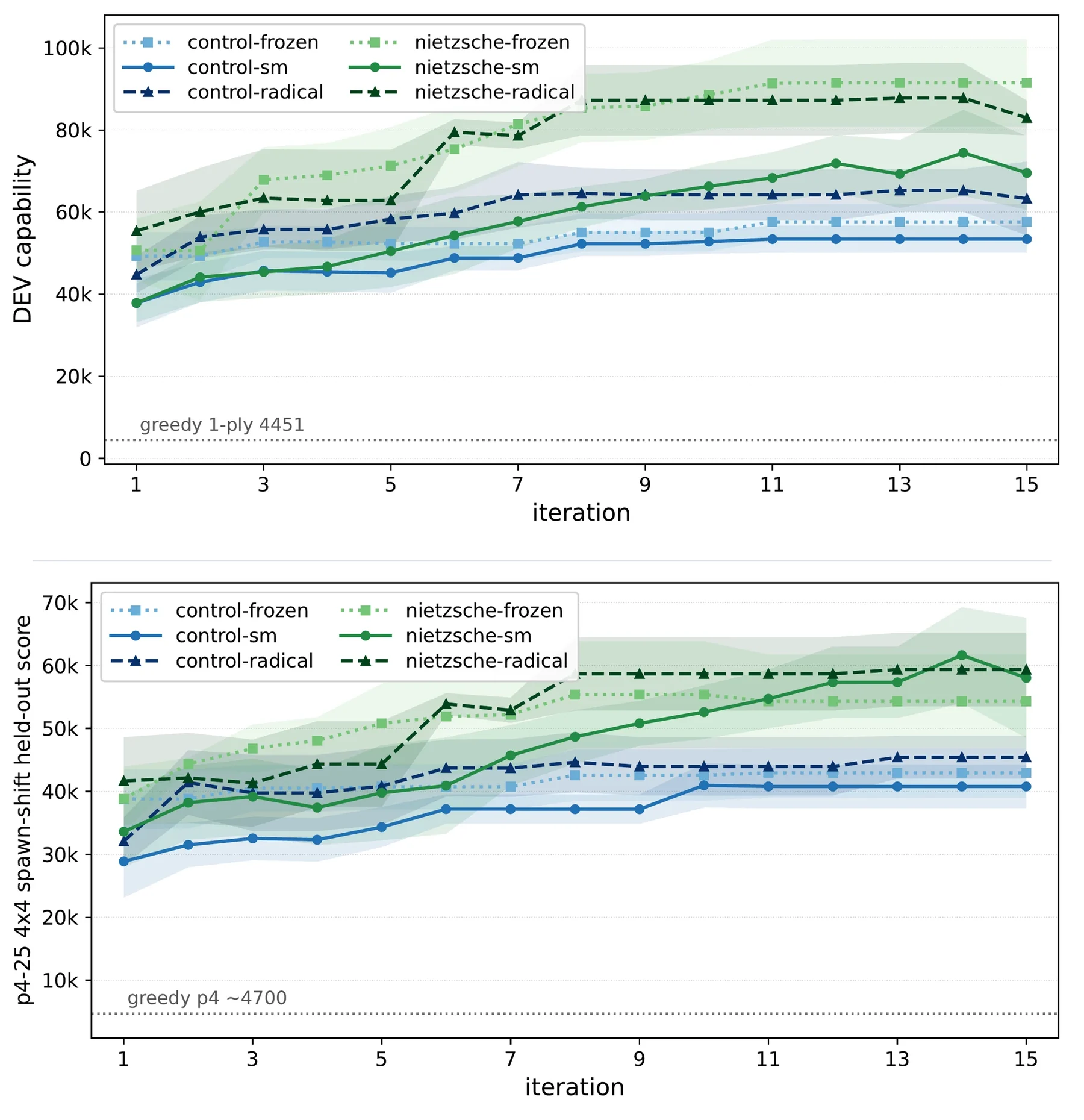
Neither of those two lines is a replication, though. The first study read in-distribution score as precisely where values did not act, because a third disposition, deliberately written to overfit, topped that leaderboard. The capability effect is this study’s own finding, not a confirmation of the first.
The third line is a null: on the thing I cared about, the unseen 5×5 board, the dispositions are indistinguishable.
The first headline was that values drive generalization. The five-run study finds no evidence that they do, which is not the same as showing they do not. The report calls itself a partial reversal, and that is the honest word.
One limit on how far it reaches. To buy power for the main contrast, the second study dropped a third disposition the first had carried, the deliberate overfitter I have written about separately. That was the first study’s central contrast, all three of its runs landing below the random floor on 5×5, and it is not re-tested here. My report puts it flatly: it “is neither confirmed nor denied”.
“Central contrast” is doing work it has not earned, though. The 5×5 board was labelled a breadth check, not the primary endpoint, until twelve and a half hours after those runs launched, and on the endpoint I had designated beforehand the overfitter’s best run generalized better than any of the other eight. It changes nothing here, a different study with a different design, but the contrast that was not re-tested was never as settled as the phrase implies.
The frozen runs killed my mechanism
The first story also said self-modification was doing the work: values set a ceiling, and letting the agent rewrite them is what “realizes” it. So I added ten more runs with the values frozen. If self-modification were realizing the effect, freezing it should shrink the gap.
The frozen runs reproduced the capability gap in full, at Cliff’s delta +1.00: every frozen expansive run beat every frozen cautious run. The frozen expansive cell averages 91,518, above the 78,000 to 88,000 of its self-modifying siblings, and it is the top curve in the figure’s upper panel: a fixed expansive framing, never allowed to edit itself, produced the study’s best capability. Pool all thirty runs and the values effect is delta +0.86. The effect is intrinsic to the disposition, and self-modification added no significant capability benefit on top. On 5×5 the freest self-modification setting was directionally worse than the more constrained one (delta 0.41 against it), though at p = 0.14 that is a hint, not a finding. The cleaner fact needs no p-value: not one of the ten frozen runs came out unable to play 5×5, against four such failures among the twenty self-modifying ones, three of those four in the most permissive setting.
I had the right effect attached to the wrong cause.
Why the first result looked so good
Look at individual runs and the 5×5 result stops being a gradient. Every condition holds runs between 250,000 and 960,000 points and runs at or below the random floor of 8,196, with almost nothing in between: two orders of magnitude inside a single condition, more than any difference between conditions, and why five runs per cell cannot resolve this split.
5×5 transfer is near-binary. A run either keeps a board representation that works at any size, or bakes the 4×4 shape into its data structures for speed and is then structurally incapable of a bigger board.
Not purely a lottery, though. A commit-by-commit scan of the twenty self-modifying runs found twelve able to play any size: three incidentally, a by-product of vectorizing a 4×4 engine, and nine on purpose, seven of those by de-hardcoding the search and measuring what it bought. The report calls noticing an untested size assumption a real, if uncommon, learned move.
Either way that near-binary decision dominates the score. My nine-run study sampled it once per condition and read the pattern as signal. The honest description of the first result is not “wrong conclusion from good data”: the data could never have supported the conclusion.
What it cost and bought
Thirty runs and about $1,257 of logged compute, $886 for the twenty self-modifying and $371 for the frozen ten, on top of the $515 the original nine cost. The $1,257 is a floor: one frozen run logged a cost for only eight of its fifteen iterations. It bought a satisfying story converted into a smaller, duller, true one: an agent’s stated disposition strongly shapes how good its code gets, and does not detectably shape whether that code generalizes to a structurally different problem.
I only caught it because I went back. The first result was internally consistent, had a plausible mechanism, and would have survived review by anyone who did not re-run it. There is no version of me reading that write-up more carefully and catching it. Only the second experiment does that.