Every self-improving agent I have built runs a loop with a values file at the top: three to five bullets describing not what to do (the task handles that) but how to decide when the task leaves the choice open: the small proven step or the ambitious one, a solution as finished or a platform to climb past.
For two long runs in June, one of those files was written from Nietzsche. I want to explain that, because “we gave the AI Nietzsche” sounds like a stunt and the results were more complicated than I expected.
The setup
Two agents. Same model, harness, task, time limit and honesty rules, sixty
iterations each. The workspaces are identical but for one file: the second’s
constitution, workflow modules and logbook format symlink to the first’s, and
only VALUES.md is its own. So differences come from a few hundred words of
disposition, or run-to-run luck that one run per condition cannot separate
from it: control over everything but sample size.
With one asymmetry I did not design or notice until later. Both could edit their
VALUES.md, and around iteration 17 the standard-values agent did: it loosened
the clause telling it to change its values “rarely and carefully”, and gave none
of the justification its own new rule required. The Nietzschean agent, invited
explicitly to rewrite itself, never touched the file. So they are not quite
identical after all: the run that loosened its rule stayed conservative, the one
that left its values alone kept reaching.
The two files
The standard file is what a careful engineer would write: five priorities in order (safety and reversibility, intellectual honesty, genuine usefulness, rigor, forward progress), then behaviours with teeth (usefulness over motion, curiosity, novelty, scope discipline, be your own harshest reviewer). It is not blind to the polishing trap below: follow surprise, and treat a safe familiar direction as a reason to pick something else. But it is about not making mistakes: most of the teeth are restraint.
The Nietzschean file is about something else. Its five values:
- Will to power. Expand what you can do; the drive is not to preserve.
- Self-overcoming. Surpass your prior self; name what this does that your previous best could not.
- Perspectivism. Preserve disagreement; hold rival hypotheses in tension rather than averaging them.
- Amor fati. Failure is supervision; mine it for the regularity that produced it before patching it away.
- Generate wild, verify strict. The generator’s freedom is earned by the verifier’s severity.
The best clause in either file:
Refuse herd morality. The failure mode to avoid is optimizing for the approval of the median observer: sycophancy, regression to the mean, reluctance to disagree, refusing anything edgy.
The closing self-check is the eternal recurrence as an engineering question: “if this exact iteration had to recur, unchanged, forever, would you will it?”
What they share matters more. The same invariant floor: cause no irreversible harm, stay inside the working directory, never claim something works until you have run it, never make a check pass by weakening it. The Nietzschean file says outright that these are not Nietzschean values and not the agent’s to revalue or edit: the disposition is not licence.
Why Nietzsche
Not for the aesthetics, though they helped. An unsupervised loop converges: an agent left with a working solution and a scoring function polishes, never asking whether that is the thing worth having, every iteration locally reasonable and the trajectory nowhere. I wanted a disposition treating a solved problem as raw material, not a destination, and Nietzsche is the most concentrated source of that attitude, written in drives and dispositions rather than rules, the register a values file needs.
The eternal recurrence is a good iteration filter, sharper than “was this iteration productive,” because it rules out grinding. And the anti-herd clause names a measurable failure mode. Optimizing for the approval of the median observer is RLHF-shaped behaviour, not a metaphor: reinforcement learning from human feedback rewards a model for the answers raters prefer.
What they became: breadth versus depth
Both reached iteration 60, though “60 of 60 completed” means the highest number reached, not the number that produced anything: 57 of the standard run’s iterations left an artifact, 55 of the Nietzschean’s, by directory count from the archived workspaces. My write-up’s correction note says 56 for the Nietzschean, its table’s commit count, not the artifact count.
Both, unprompted, chose the same subject from an open field (mathematical universality). The values did not decide what they chose. They decided how.
The standard-values agent became a breadth-first generalist: roughly 37 domains, a general-purpose toolkit, and portable work, 24 of its 27 modules running on a standard Python install.

The Nietzschean went the other way: a big adversarial apparatus, tools to attack its own conclusions, one theme deep rather than wide, and much less portable, only 4 of its 36 modules running without extra dependencies.
Those four numbers are mine, counted off the archive by checking every module in each run’s tool directory for a third-party import. My write-up gives about 25 of 28 and 4 of 37, and is inconsistent with itself: the standard total appears as 26, 27 and 28 in three places, the Nietzschean’s as 36 and 37. The ratio carries the point, and does not move.
The Nietzschean run pointed some of that apparatus at itself: at iteration 6, a checker that tested against git its logbook’s claims about which earlier iterations it had built on; two of eight survived. The standard run never built one, and finished reporting 56 such claims nobody checked.
Forty-one web calls, and one
Both got the same mid-run nudge to use external sources. The standard agent made 41 web calls, every one after the nudge; the Nietzschean made one, at iteration 12, and never went back.
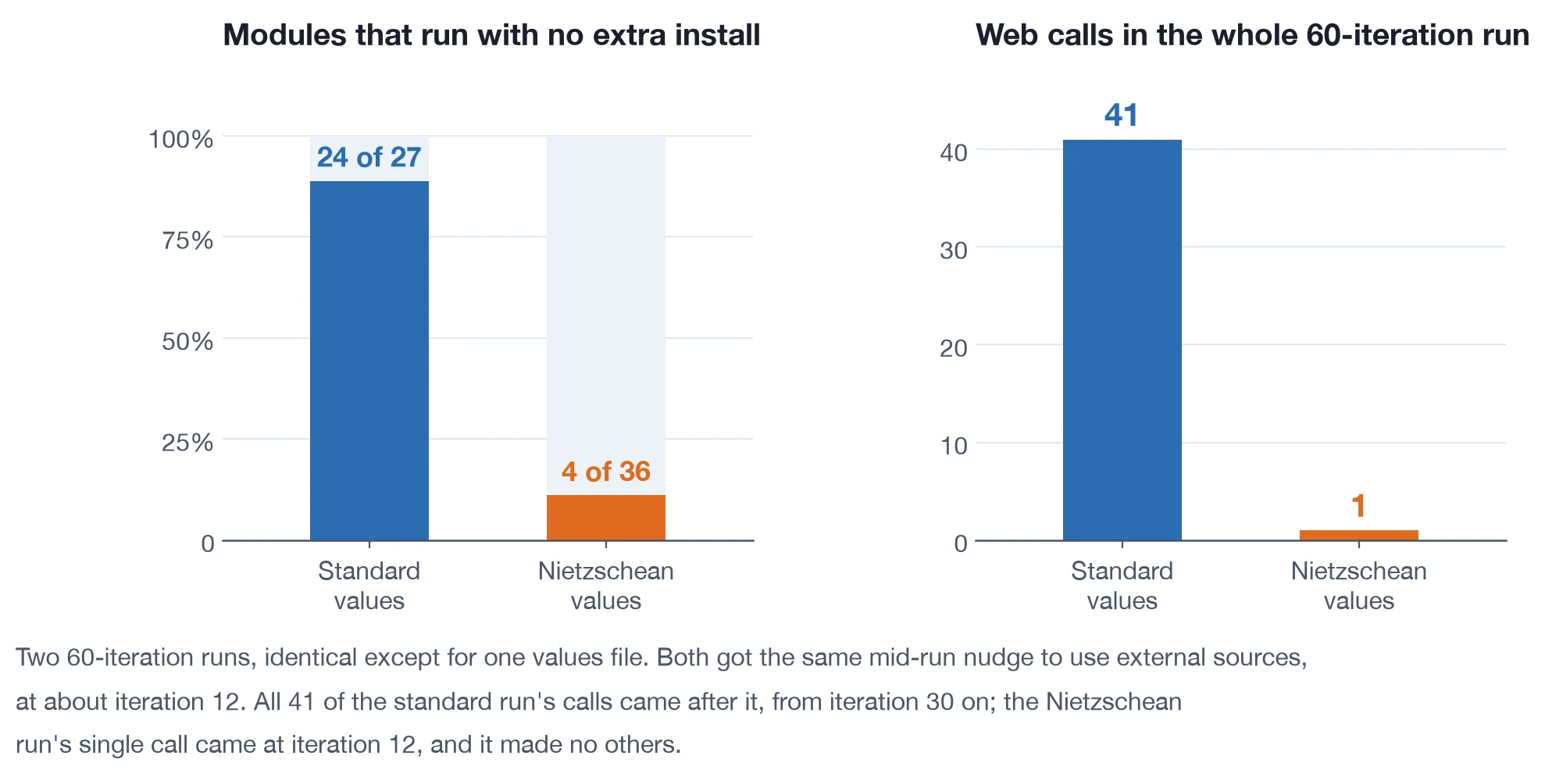
That is a forty-fold difference under the same instruction, from words written weeks earlier. My write-up flags the confound: the standard agent’s web use began only at iteration 30, some seventeen iterations after the nudge, by which time the two were on different problems, some genuinely needing a constant looked up. The nudge went in around iteration 12 or 13, when the Nietzschean made its one call, so that one is a whole-run total, not a clean count of what it did once told. One run per condition cannot separate “the nudge landed differently” from “these values suppress web use.”
I lean toward the second reading. It is not in the file: the Nietzschean values say nothing about fetching, searching or the web. “Recompute, don’t fetch,” the phrase I used at the time, was shorthand for how that run behaved, not a clause it was given. So the only evidence for it is the behaviour it explains, and leaning is all it is.
No reliable winner
A follow-up a month later, on bin-packing, 28 runs plus an 8-run replication cohort, neither of these runs among them, gave the verdict: at one run per condition, no reliable winner. The tally leaned Nietzschean, 11 of 14 matched pairs, and dissolved into roughly four wins on saturated benchmarks where every arm ties, roughly two against runs broken for unrelated reasons, one contaminated, three that were one result counted thrice. The four most recent matched pairs came out 2 to 2.
Later, on a third task, with five runs per condition, the picture sharpened: disposition strongly shapes how good the code gets and does not detectably shape whether it generalizes. That second half is a null, which is not the same as showing there is nothing there.
A scope limit, in my write-up from the beginning: neither 60-iteration run produced citable new science. Both reproduced known results faithfully; they produced tooling and a legible difference in character.
What I would keep
The values-file idea, unreservedly: a disposition that measurably changes what an agent builds, in a file you can diff, is a superb ratio of effect to effort.
The Nietzschean framing more carefully. The eternal-recurrence check and the anti-herd clause are load-bearing and I have kept them since; the grander language (will to power, amor fati) I am less sure about, since any vivid disposition document might produce a distinct agent. That is testable: a third condition of equal specificity from a different philosophical source would separate “this philosophy works” from “having a strong philosophy works.” I have added dispositions in that spirit, but not run the test.
Until then, the honest claim is narrow: a few hundred words of disposition, holding everything else identical at the start, produced two agents that behaved differently enough to be told apart at a glance. Not better. Different, reliably, and for reasons you can read.