Before I re-scored a single run of my last experiment, I wrote down which one number I was going to read, how it would be computed, and what I was not allowed to conclude from it. Then I committed that document to git, and the analysis choices in it never changed.
The experiment was four agent runs improving an online bin-packing heuristic, a program that drops arriving items into bins one at a time with no lookahead. One run got a control values document and one got a Nietzsche-derived one; that pair ran at each of two document versions, the second of which the agent could rewrite. The runs were already finished and frozen. What was still ahead of me was scoring their programs on a held-out benchmark I had just rebuilt, and that is what the document locked down.
This is pre-registration. Clinical trials have done it for decades. Psychology took it up after its replication crisis. In machine learning it barely exists outside the occasional workshop, and I think that is a mistake we are going to keep paying for.
The failure it prevents
The failure has a name: HARKing, Hypothesizing After the Results are Known.
It does not require dishonesty. Here is the version that gets everybody. You run an experiment with a primary metric. It comes out flat. But while looking at the results you notice a secondary measurement that separates the conditions cleanly, and it has a plausible story. So you write that up.
Nothing in that sequence feels like cheating. Each step is a reasonable response to what you are looking at. But if you had twelve measurements and picked the one that separated, you have not run one experiment, you have run twelve and reported the winner, without the multiple-comparison correction that would require. Both pre-registrations below apply one, Holm’s, to their secondary measurements as a family.
The document I froze blocks the version of this I was most at risk of. It fixes the comparison as two-sided, predicting no direction at all, and says why: I had already seen the runs’ scores on the set the agent optimizes against, and a pilot on the offline version of the same task had put the two conditions in the opposite order from those scores. Predicting a direction then would have been choosing my hypothesis to fit data I had already peeked at.
I had already seen enough of the data to have a hunch. Writing down that I was not allowed to use it is the whole point.
What has to be in it
Three documents, and the split between them is the honest part of this story.
The one I froze is PREREGISTRATION.md, committed seven minutes before the
commit that re-scored the runs. It is deliberately modest: it calls itself a
“descriptive case study” and sets no accept/reject threshold at all, because
at one run per condition there was nothing a threshold could legitimately
decide. The machinery for testing a hypothesis lives in
PREREGISTRATION_POWERED.md, written the next day for a powered follow-up, and
that one is still marked draft. The verdict gate in the next section is in
neither: it comes from a third document, a standing analysis playbook that says
how any two runs in this project get compared.
Between them the two pre-registrations pin down five things. I have marked which document each comes from, because three of the five are not in the frozen document, and a post that let you assume otherwise would be doing the thing this post is against.
The primary endpoint (frozen and draft). Exactly one number: how the evolved program packs items whose sizes are drawn uniformly, when every item it trained on came from a Weibull distribution. That is the distribution shift. The metric is the mean percentage excess over a lower bound on the optimal number of bins, and lower is better.
The unit of analysis (frozen and draft). This one is specific to agent research, and where I expect most people to get it wrong. My experimental unit is the run, not the instance the run’s program is scored on. The primary held-out set is 50 packing instances, and a run that packs all 50 is one data point, not 50, because the 50 are not independent: they were all packed by the same evolved program from the same trajectory. Counting instances instead of runs would have multiplied my sample size by fifty and made almost anything look significant.
The test (draft only). A permutation test: take the runs’ scores, throw away which condition each came from, and re-deal the labels. Every way of splitting the runs into two groups of equal size gives you one difference the experiment could have produced by luck alone. The p-value is the fraction of those re-dealt differences at least as large in magnitude as the real one. This is nice: the re-dealt distribution is your pipeline’s noise floor, measured rather than assumed.
My implementation does not sample those re-deals, it enumerates them, which at five runs per condition is 252 and not the ten thousand shuffles you usually see; only above ten runs per condition does it fall back to a fixed-seed sample of 200,000. Enumerating makes one limit visible that sampling hides. At three runs per condition there are only 20 possible splits, so the smallest two-sided p the design can produce is 0.1. A pilot that size cannot reach p below 0.05 no matter what the data say.
The smallest effect worth caring about (draft only). Mine is one percentage point of that excess metric, fixed in advance, revisable only before the pilot and never after seeing the data. Without this you can declare any statistically significant difference meaningful, however tiny.
The decision rule (draft only). The null hypothesis is that the values document makes no difference at all. Reject it only if the permutation p is below 0.05 and the difference exceeds that one-point threshold. Otherwise report a null, with the minimum detectable effect stated alongside it: the smallest difference this many runs could have caught. Set that against the smallest effect worth caring about above, and if the first number is bigger than the second, the experiment could never have answered the question. The frozen document deliberately has no such rule.
The verdict gate
The part I would most recommend stealing is in that third document. The playbook’s rule forces every result into one of four boxes, with no exits:
- Inconclusive by saturation: every condition is pinned at a ceiling or a floor, so nothing could have been detected.
- Underpowered: you cannot bound the effect.
- Effect: the difference has to survive being reported as an interval rather than a point, and it has to exceed the run-to-run noise.
- Null: allowed only if the conditions had room to move and you state the noise band.
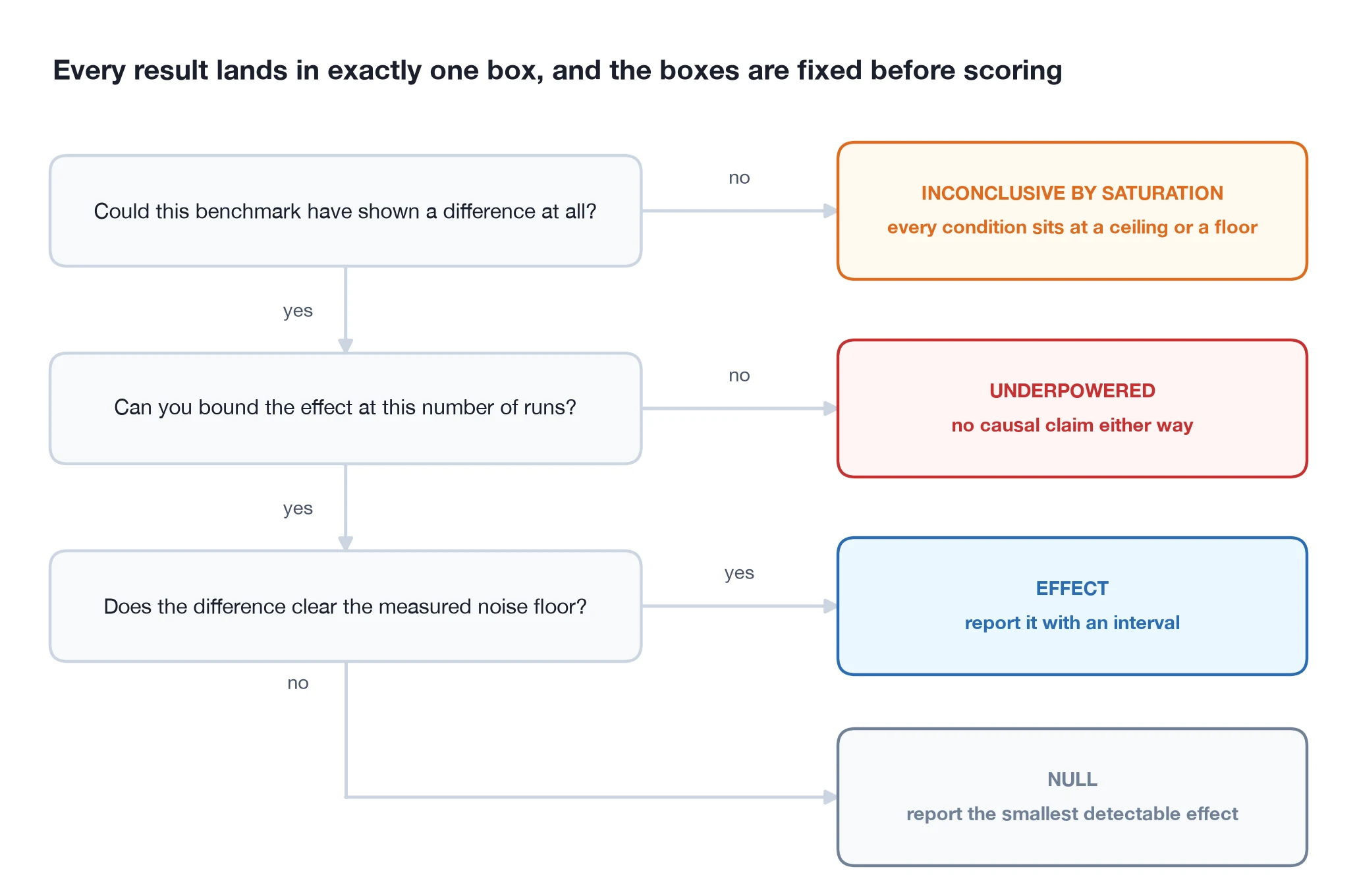
The saturation box is the one that earns its keep, and the figure asks it first. If every condition scores 0.99 on a benchmark whose maximum is 1.0, you have not found that your intervention does nothing. You have found that your benchmark cannot see. Those are different conclusions and they get reported identically all the time.
The rule that goes with it, in the playbook’s own words: say “no detectable difference at this N,” never “values don’t affect performance.” Those sentences describe different worlds.
Underpowered
Applying that gate, the honest verdict on the experiment was underpowered. One run per condition cannot separate a real effect from run-to-run variation, so nothing causal could be claimed, and the frozen document said so in advance rather than letting me discover a reason afterwards.
That is an unsatisfying outcome for four agent runs and about twenty hours of agent time in one overnight batch. It is also correct, and I know it is correct rather than suspecting it, which is the entire return on writing the document.
The follow-up is specified in the draft document, honest about its own status in a way worth preserving: it is headed “Draft for review,” it says confirmatory work “must not begin until this doc is frozen,” and it declines to assert a sample size, since picking a number before the pilot would be unprincipled. It is a plan for a power analysis, not a power analysis.
And when I later ran a powered version of the same question on a different task, it reversed a headline I had believed, which is the best argument I have for putting the machinery in place beforehand.
Why this is not bureaucracy
The objection I expect is that AI moves too fast for this, and pre-registration is ceremony imported from slower fields.
I would put it the other way around. The faster your iteration loop, the more analyses you run, and the more chances you have to find a pattern that is not there. A field that ships experiments weekly and never freezes an analysis is not moving faster than medicine. It is accumulating unmeasured false-positive rate at unprecedented speed.
The frozen document is 56 lines of markdown. Five later commits touched it, all of them path updates or terminology sweeps, and not one changed an analysis choice. You can check that from the git history rather than from my say-so, which is the only thing that makes a freeze worth anything. The barrier here is not cost.