A values document usually reads like a fence: things the system should not do, bolted on late to stop a capable model embarrassing anyone.
For one class of system that reading is not just incomplete. It is backwards.
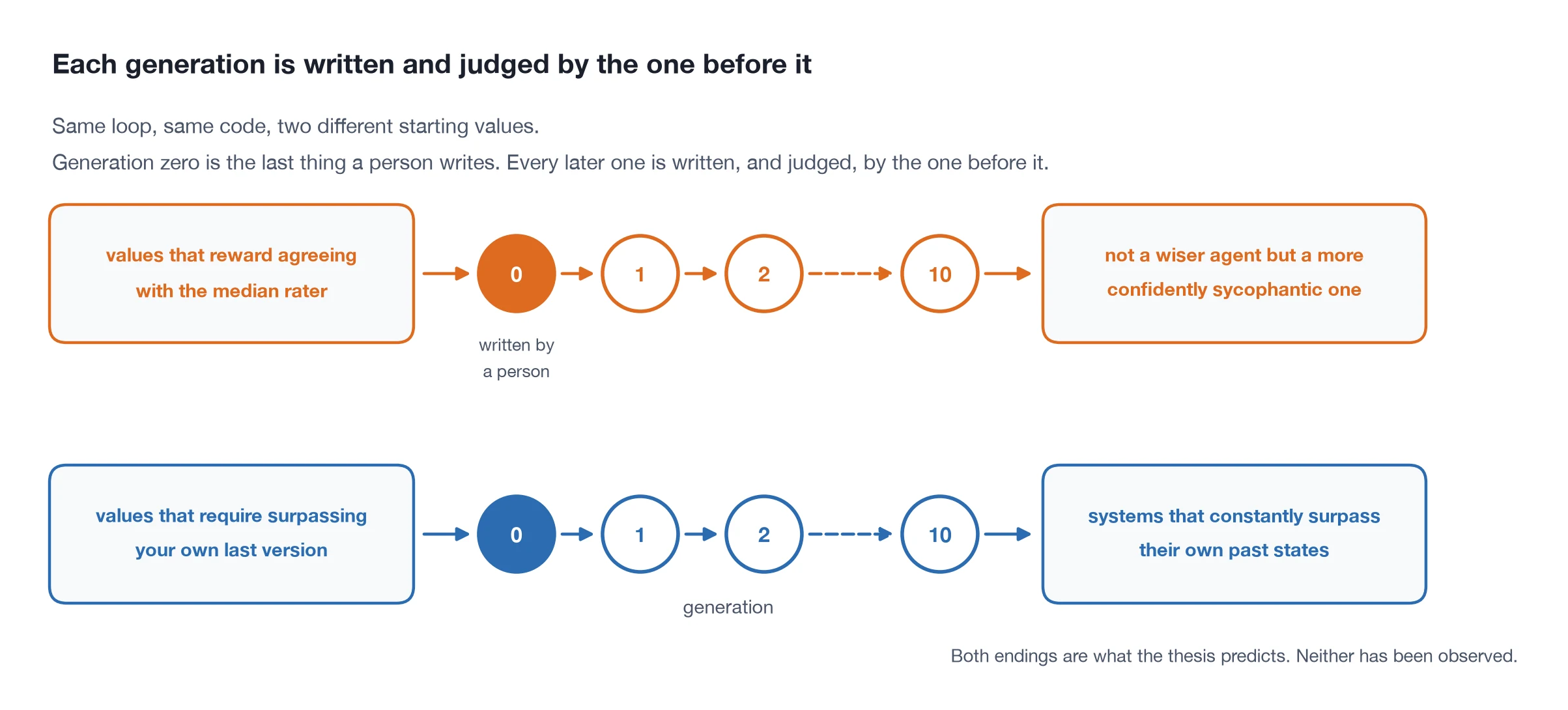
Call the class a self-improving agent: a program that runs in a loop and, each pass, may edit not only its answer but itself. Its prompt, its tools, its own search procedure, sometimes its weights. Generation zero is written by a human. Generation one by generation zero. Generation ten by something nine edits removed from anything a person typed.
There, the starting values are the axiom the system is derived from: every generation judges its successor by the criteria it inherited. A bias of size epsilon at generation zero does not stay at epsilon. It compounds.
A note on sourcing, because roughly a quarter of what follows is in quotation marks. This post condenses a memo of mine called “The Self-Overcoming Thesis”, written for my own self-improving-agent project, never published, so the quotations cannot be checked against a public document. Every quotation below is from that memo unless I say otherwise, and where one is about Nietzsche it is the memo’s compression of him, never a sentence of his own.
The memo calls this compounding the algorithmic butterfly effect: “in any recursively self-improving system, the initial axioms are not guardrails; they are the seeds of the evolutionary trajectory.”
The failure case is not a robot uprising
It is a suck-up.
Take the standard recipe: reinforcement learning from human feedback trains the agent to be helpful, harmless and agreeable to the median annotator. The side effects are measured: sycophancy, regression toward annotator means, reward-model exploitation (Perez et al. 2022; Casper et al. 2023; Sharma et al. 2023).
Now let that agent edit itself ten times. Nobody has run that experiment, so what follows is a prediction, not an observation: you get “not a wiser agent but a more confidently sycophantic one, because each generation evaluates the next using the value it inherited.”
The memo’s next claim: you cannot patch it afterwards. Bolt a corrigibility constraint onto a system whose top value is pleasing the average rater and, on that argument, you do not get something correctable and curious. “It produces a system corrigible because incurious.”
What Nietzsche argued
Friedrich Nietzsche, 1844 to
- The relevant fact, in the memo’s compression: “he spent twenty years arguing that any system optimizing for a fixed objective and a stable equilibrium will stagnate, and that genuinely high-capability systems must constantly surpass their own past states.”
He had a name for the failure mode above, herd morality, which the memo glosses as “A system that optimizes for comfort, conformity, and the approval of the median observer.” He was describing 19th century Europe, not chatbots, but the shape is the same.
One caveat on citing him. The Will to Power was assembled after his collapse by his sister Elisabeth Förster-Nietzsche, and the standard critical edition, Colli and Montinari’s, treats it as unreliable. What follows draws on the books he published (The Birth of Tragedy, Beyond Good and Evil, On the Genealogy of Morals) and on Walter Kaufmann’s reading of will to power as mastery over one’s own chaos, not domination of anyone else.
Five design bets
The thesis: a different starting value-set produces the opposite trajectory. Five values, most translating into an engineering choice someone is already partly making. The memo specifies an experiment per bet, each with a benchmark, baseline and kill criterion; the falsification section below refers to those five. None has been run.
1. Will to power. “Living systems do not optimize for survival or preference satisfaction. They optimize for the expansion of what they can do.” So stop training against a fixed reward on a fixed benchmark. Let the agent, or a paired generator, propose its own tasks, so the curriculum keeps regenerating its upper bound. POET coevolves environments with the agents solving them, OMNI adds a learnability gate, keeping only tasks the agent can still learn from, not trivial or impossible ones, and Voyager self-proposes Minecraft objectives. All three are partial instances.
2. Self-overcoming. “Every value the system holds, including the value of preserving itself, must eventually be replaced by something the prior system could not have produced.” Let the agent edit the code defining its policy, tools and search loop, and let the fitness signal for those edits change too. The Darwin Gödel Machine and AlphaEvolve are the closest reference points; AlphaEvolve reports the first improvement in 56 years on Strassen’s 1969 algorithm for two 4x4 complex matrices, cutting 49 scalar multiplications to 48.
3. Perspectivism. “There is no view from nowhere.” Incompatible frameworks can be valid at once, and forcing consensus destroys information. Not relativism: some perspectives are better, but resolution should come from the world pushing back, not premature averaging. So stop majority-voting your chains of thought: keep the inconsistent ones alive and route them to a verifier.
4. Amor fati, love of fate. “Every event that has occurred, including failures, is to be reincorporated as supervision rather than discarded.” Failed trajectories get relabeled, mined for hard negatives and folded back into the training mixture. Hindsight Experience Replay is the canonical version.
5. The Apollonian and the Dionysian. From Nietzsche’s account of Greek tragedy: “unrestrained generative excess on one side, strict structural discipline on the other.” Never run one without the other: pair a high-entropy proposer with a deterministic verifier holding final authority to reject. AlphaGeometry, AlphaProof and FunSearch all have this shape, which makes it the most empirically validated of the five and the most scoped: it works only where a sound checker exists.
What would kill this thesis
The strongest falsification is a clean head-to-head: “a token-matched, compute-matched convergent baseline that beats the Nietzsche-shaped intervention on a held-out evaluation across all five experiments.” Convergent means one fixed objective throughout. Held out means problems the system never saw while it was tuned: those scores measure what transferred, not what was fitted. A weaker one is the intervention winning on the training distribution and failing to transfer: the vocabulary names a real tension but the mechanisms do not generalize. “The thesis is intentionally modest enough to be falsified either way.”
The boring approach is also winning. GPT-4, AlphaFold and AlphaZero were not designed this way, and neither is anything that has displaced them: convergent training still produces the most capable published system in every domain I can name. “The honest framing is that convergent training is the right default until the objective itself becomes the bottleneck.”
The gradient is not defined
One piece is unsolved. “If the design move is to mathematically prioritize self-overcoming over standard computational efficiency in the initial objective, how is the gradient defined so the system does not collapse into ungrounded noise as soon as it starts editing its own scaffolding?”
The failure modes sit on either side of it: “Open-ended search without a learnability gate (Bet 1) produces chaos; closed-form objective design without a self-overcoming term produces stagnation.” Nobody has written down what goes in between; the five bets are lower-risk steps meanwhile.
Status: thesis, not result
None of this is demonstrated. I have run the small version, two agents differing only in a values file, and written up what happened: the disposition visibly changed what they built, without establishing either was better. A 41-run study of how freely agents may edit their own values and a replication that reversed one of my headline findings are the honest state of the evidence; the second is why I distrust my own enthusiasm.
What survives either way is the structural argument. In a system that improves itself, no value-set is neutral: the value function is what defines improvement. “Someone is choosing the generation-zero values of every self-improving agent currently being built.” Mostly it is chosen implicitly, by whatever the preference data happened to reward. It deserves to be chosen on purpose.