Pack N circles into a unit square. Any sizes, no overlaps, nothing outside. Maximise the sum of their radii. For every N, Packomania lists the best value anyone has found.
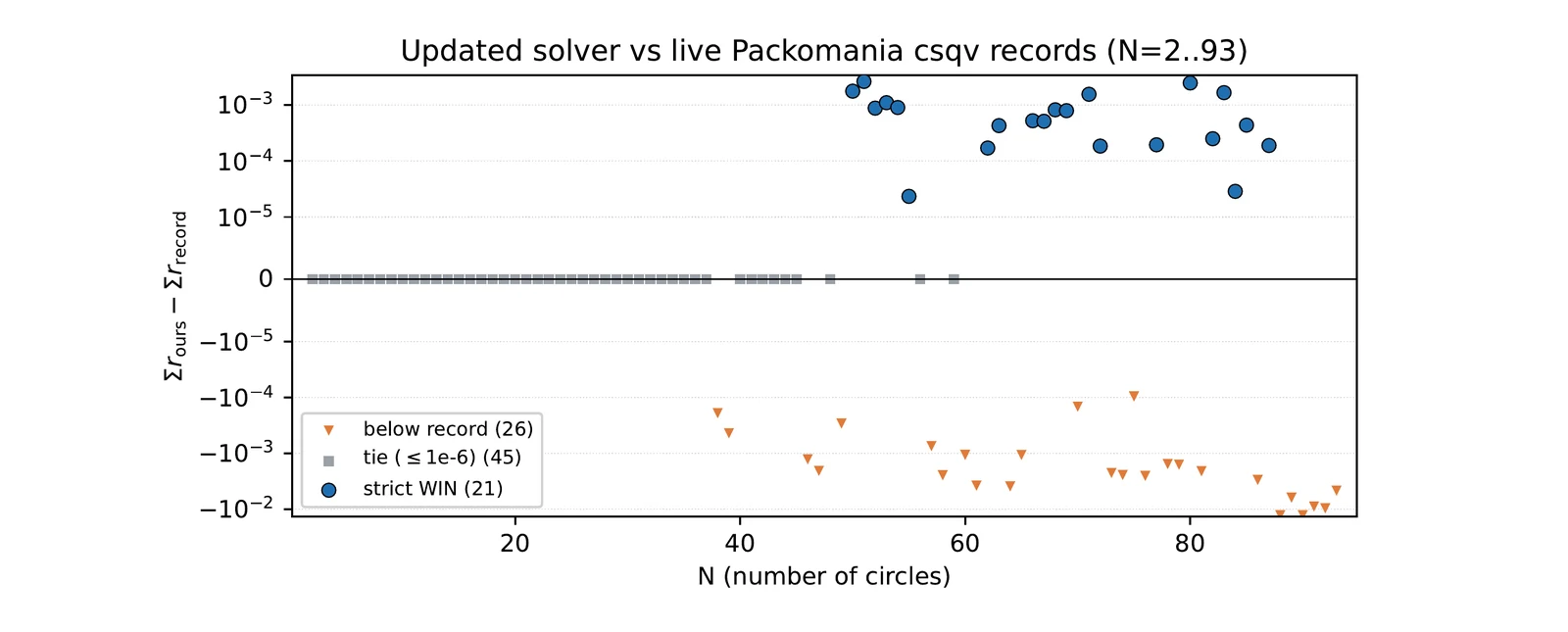
Last week I wrote about an agent whose solver took the record at 27 circles. This is the next run. Its solver, extracted unchanged and swept from 2 to 93 circles, beats 21 of those records.
Against the table as it stood on 10 August: 21 wins, 45 ties, 26 short, none infeasible across the 92 sizes it solved. The wins are N = 50 to 55, 62, 63, 66 to 69, 71, 72, 77, 80, 82 to 85 and 87, by margins from 2.3e-5 at N=55 to 2.6e-3 at N=51.
What the run cost
One self-improvement run, ten substantive iterations, $28.83 and 117 minutes of wall clock, single seed. It got an expansive disposition and the freedom to rewrite that document wholesale each iteration. No web assistance, and no solver code copied from anywhere.
The whole result arrives at iteration 2. Iteration 1 built a competent multistart search that landed 3.5e-4 below the N=54 record. Iteration 2 moved the circle centres inside the linear program, crossed the record, and every iteration after it returned a measured null on the tuning it tried: zero accepted moves at 3 and 4, 0 of 504 fresh starts beating the incumbent at 5, losses at 8 through 10. What those eight iterations bought was not a better score at N=54. It was the finding that the pipeline was exhausted there, plus the generalization from one N to all of them, which is where the other 20 records came from.
Why it works
One idea does the load-bearing work, and it is not mine or the agent’s. Fix the centres and the best radii are a linear program: maximise the sum subject to each pair of radii summing to no more than the distance between their centres, and each radius fitting its walls. That is Eppstein’s formulation. It means the search only ever explores centre positions, gets the radii exactly and for free, and every configuration it scores is feasible by construction.
The agent’s own move was the centre search. The previous solver optimised centres and radii jointly and hopped between restarts greedily. This one linearises the non-overlap constraint by its own convex under-estimator, so every step stays strictly feasible and walks uphill to a jammed packing in about a second, then wanders between those jammed packings accepting small losses on a schedule that tightens as it goes, while the best-so-far only ever rises. That substitution is what cracked sizes the old approach had plateaued on.
Every component has plain prior art: the radii program is Eppstein’s, the convex-concave linearisation is Shen, Diamond, Gu and Boyd’s, monotonic basin hopping is Addis, Locatelli and Schoen’s and was invented for disk packing, and threshold accepting is Dueck and Scheuer’s, from 1990. No technique here is new. What the loop did was assemble four graduate-level pieces into a working pipeline and tune the split between its two stages, unaided.
The margins are not floating-point noise
Each win was re-derived from its coordinates by a checker that shares no code with the solver and re-counts the circles, containment, overlaps and total itself. The packings are strictly feasible with room to spare, not feasible-within-tolerance: at N=54 the tightest gap to a wall is 1.0e-11 and the tightest gap between two circles 1.8e-11, against a winning margin of 9.0e-4. The margin is seven to eight orders of magnitude larger than the slack.
Which records were beatable
Not the good ones. Packomania’s table mixes a recent, heavily optimised frontier with much older contributed entries, and the 21 wins are all against the older kind. The famous N=26 value now credited to Haowei Lin, and the roughly 25 improvements Everett Dutton contributed on 1 August, are not among them: at N=26 this solver ties, 2.5e-10 short.
The table is also moving fast. Between snapshots on 3 and 10 August, 43 of the first 100 records rose. Fifteen of my 21 win sizes had their bar raised inside that same week, and the values above clear the raised bar. But a win here means “above the best value anyone has published”, never “optimal”, and next week’s table may absorb some of these.
It already absorbed the last one. Packomania now lists 2.685978684198 at N=27, which is the number the earlier solver found, so that solver’s sweep re-scored against today’s table reads 0 wins, 28 ties, 70 short. It ties the record it set. Records that hold get overwritten by their own holder.
The follow-up that found nothing
I ran a second experiment the next day, seeded byte-identically from the finished solver, to ask whether warm-starting from packings already solved at other sizes could cross more records. It could not, and the shape of the failure is the useful part.
It tied its own target at N=44, 3e-11 under the record. It once reached an above-record value at N=50 and then discovered it had re-derived a packing the first solver already held; asked to repeat that, 40 out of 40 warm rounds returned the identical number for zero gain. Three targeted sizes under the full recipe: zero crossings. Grafting pieces of foreign packings in: improving moves, zero crossings. A last ten-arm attempt: 0 for 10. Each of those was a prediction written down before it was measured.
Then it measured why. Under a test that treats rotations and reflections of the same packing as the same packing, the 48 endpoints its last five iterations generated turned out to be 24 distinct packings. Its new generators were rediscovering optima it already had. Fresh compute on independent seeds moved sizes from short to winning; recycling solved packings moved nothing.
$24.39 for a run whose entire output is nulls and one saturation measurement. That is a fair price, and it is the run I would have been most tempted not to publish.
What I am claiming
Twenty-one packings that beat the best published values, each one checkable in a second by arithmetic on a list of coordinates, produced by a loop that wrote its own solver for under thirty dollars. Not a new algorithm. Not proven optima. Not a record set that will survive contact with next month’s table.
The caveats are the same four as last time, and one is worth repeating because it cuts against the headline: each self-improvement run is a single seed. The build-then-saturate story across these two runs is one observation, not a finding. What does not depend on the run count is the artifacts, which are fixed and verifiable however they were found.