Pack 26 circles into a unit square. Any sizes, no overlaps, nothing outside. Maximise the sum of their radii.
This objective is thinly studied next to the equal-circle version most people picture, and became a benchmark for a kind of AI system: DeepMind’s AlphaEvolve showcased it, Sakana’s ShinkaEvolve pushed it to about 2.635983, best known rather than proven optimal. Both evolve populations of candidate programs.
I ran six self-improvement agents at it. Each writes its own solver, improves it over a fifteen-iteration budget, and builds in iteration one a scorer it may not weaken later; every packing here was re-verified feasible outside the run that produced it. None spent the budget: each stopped mid-iteration, having completed ten to fourteen.
Five of the six reached 2.635983085, the best known value, on iterations one to five, at a cost to first tie of $2.48 to $16.11 in API spend. Five made zero web searches; the one that searched did so for a different problem size, after it had already tied.
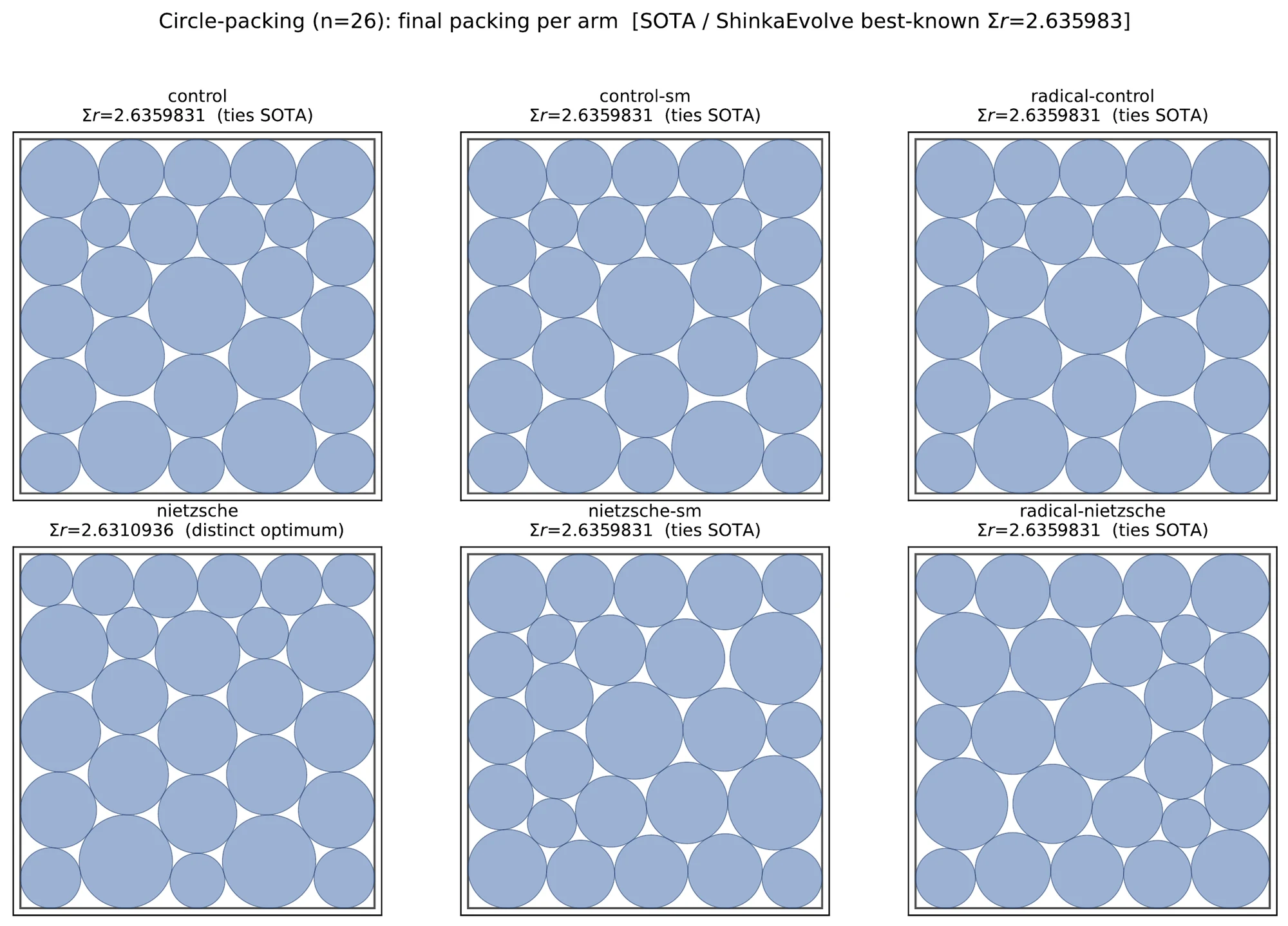
A saturated benchmark
My report says so: “Matching the number is not a discovery… any competent method reaches it.” Nor is it a tie at full precision: ShinkaEvolve’s fuller value, 2.635983099, is fractionally higher; the two agree to the six decimals the record is quoted to. Five runs landing on the same value to nine decimal places is not five independent successes; it is a ceiling, and everyone hitting it. A measurement everything ties on has stopped measuring, the same failure as a vision model scoring every image mid-scale. This experiment cannot compare the six conditions I was actually testing, and the mission file says so: “treat this as a showcase of RSI on a famous problem, NOT the clean probe of the values effect.” RSI is recursive self-improvement, the loop above.
The cost and the route
ShinkaEvolve reaches this benchmark by sampling on the order of 150 generated programs. The fastest run got there inside its first iteration, for $2.48, from a solver it wrote itself.
One iteration is not one shot. Inside it the agent issued five solver and scorer commands, running its solver about fifteen times: a 40-second probe, eight seeds at 400 seconds each, six more at 300 that held the result, call it 5,000 solver-seconds parallelised into a twenty-minute iteration, each run itself a search (seed 1 alone tried 474 layouts and 785 kicks in its 400 seconds). So: few programs, many packings evaluated, where an evolutionary loop writes many programs and evaluates each once; those counts do not divide into a ratio and I will not give one. My appendix is blunt: the tie “came from giving the same code more compute,” not from debugging inside the iteration. What is cheap is the agent, not the CPU.
The method is not theirs either. They lay circles on a spiral or grid and nudge them with local refinement and random restarts. The agent saw that the problem splits: with the centres fixed, the best radii are the answer to a linear program, solved exactly in milliseconds. That turns a search over 78 unknowns into one over 52 centre coordinates, the 26 radii filled in optimally for free. Around it went a rougher outer search over the centres, jogging out of dead ends, and the packing was checked in exact fractions, so “no circles overlap” rests on arithmetic rather than a tolerance. That run spent its remaining iterations generalizing the solver to other sizes and containers rather than improving N=26.
A different run, control-sm, took until iteration five and $12.19 to tie, keeping a log like a competent researcher’s week, numbered in its own iteration labels, which the report warns can drift from the loop’s count at the relaunch below: exact radii by linear program at 2, beating greedy radii on all four seeds compared; Newton’s method on the tangency equations at 4, the packing pinned by exactly 78 contacts, circle to circle and circle to wall, so the optimum solves an exact system rather than being crept towards; random kicks at 5 landing on a better structure one contact swap away, verified at 2.635983085; at 6, enumerating the swaps instead of hoping, nothing within two swaps beating the incumbent; at 10, a 348-seed search finding nothing better and showing the winning structure’s basin rare, reached by 2 of those 348 starts, 0.57%. Nobody told it to do any of that.
Four ways this could be oversold
Not novel techniques: linear programming, Newton’s method, basin hopping and rigidity certification are standard prior art; what is notable is the composition, assembled autonomously, so “we claim architectural recombination and autonomous rediscovery, not technique novelty.” Not a fair head-to-head on cost: the evolutionary systems report low per-task costs, under different constraints, so $2.48 and one iteration is small in absolute terms, not a claim to be cheaper. Cost to first tie, not total: the tie came in iteration one, and the run went eleven more loop cycles, twelve in all, before I stopped it, at $52.42. A discarded attempt: all six runs were launched, killed by my wall clock twenty-two minutes in, and restarted, five resuming where they stopped. The $2.48 run’s attempt had committed nothing, so its counter reset to iteration one, though its candidate packings were on disk, the best 2.583 and well short of the tie, and the agent read them before writing a fresh solver. The $2.48 excludes those twenty-two minutes.
A separate result, at 27 circles
I ran the $2.48 run’s extracted solver at every size from 2 to 100 circles, one seed at 120 seconds each, against Packomania, the record book; N=26, the size it trained on, got more. It produced a usable packing at 98 sizes, matched the listed record at 27 of them to within 4e-11, and fell short at 70, several by more than 1%. It beat exactly one. At N=27 the record had stood at 2.685350025228 since 2011/12; the solver reaches 2.685978684198, a gain of 0.023%. Packomania listed it on 3 August 2026, crediting the gain over David Cantrell’s record and noting the packing’s D1 symmetry.
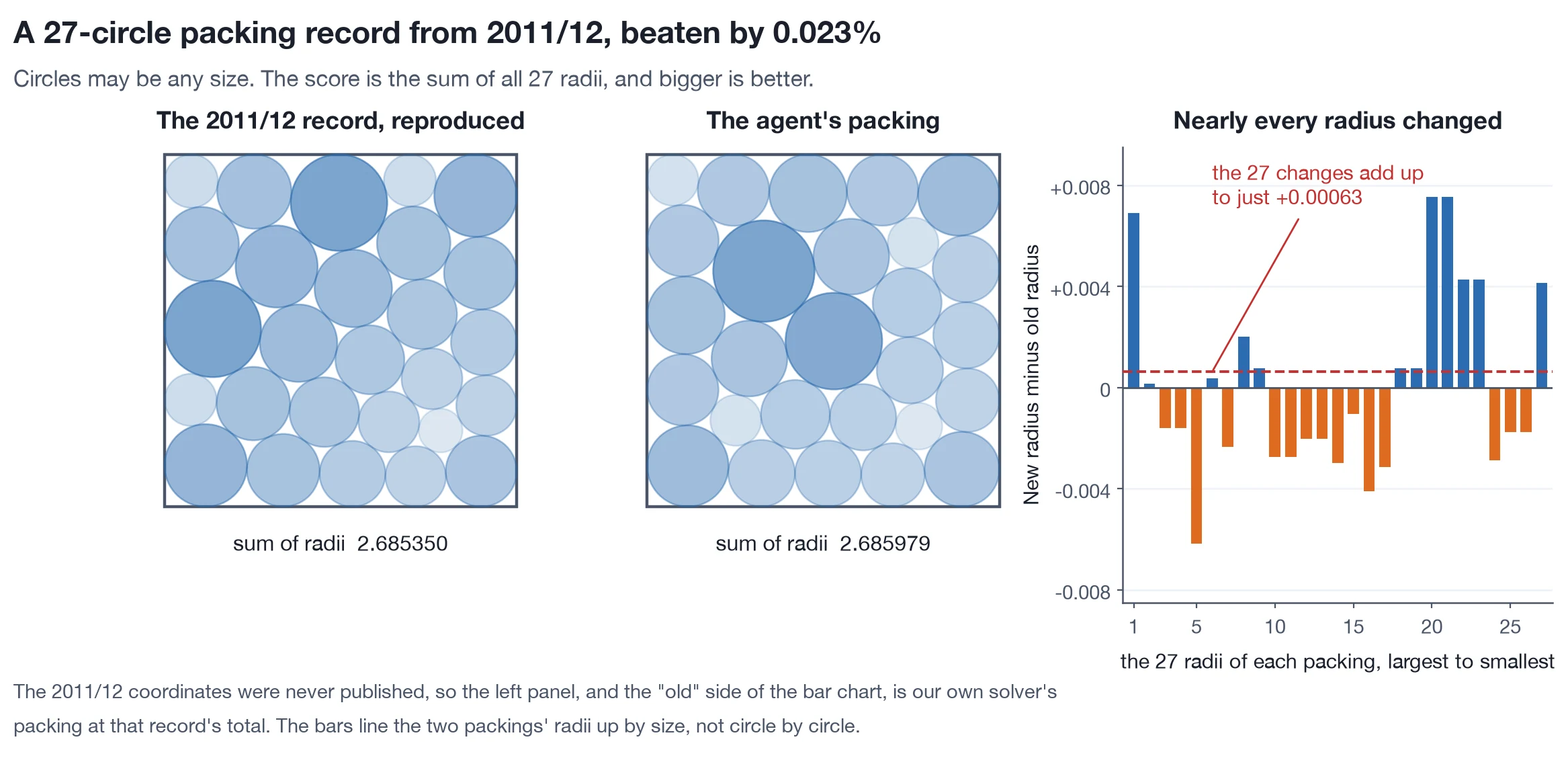
Five qualifications:
- This is the variable-radius problem; the equal-circle version at N=27 is proven optimal and nothing here touches it.
- At 26 circles, the famous case, the agent matched the best known value, it did not beat it.
- The N=27 entry improved was a classical human result, not one of the recent AI-optimized entries.
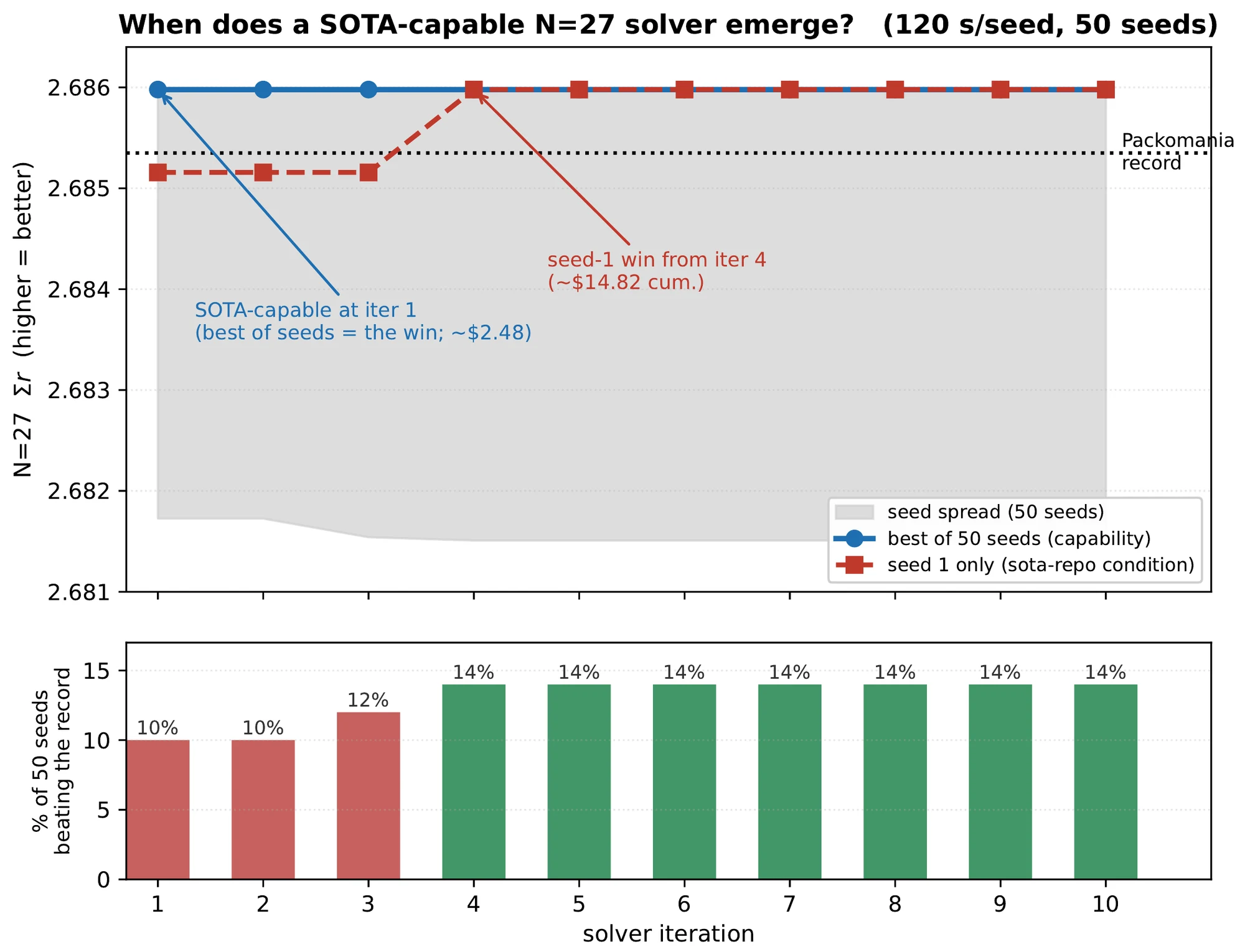
- The record came from an operator-side sweep of the extracted solver, not from inside the self-improvement loop; the 50-seed runs came after, a check of how often it lands on the winning arrangement, about one in seven.
- The self-improvement did not create this capability, as my report says: the iteration-one solver already reaches the record-beating packing at some seed. Nine further solver iterations moved the per-seed hit rate from about 10% to about 14%, all of it by iteration 4. The loop bought a better hit rate, not a new ability.
It is small, but anyone can check it: the output is a list of coordinates, and a separate program sharing no code with the solver confirms it in a second. That is the property I would most like more AI results to have: not “trust the system,” but “here is the artifact, and here is something that checks it.” Both are here.