If you build an agent that improves itself in a loop, you eventually face an awkward design question: should it be allowed to change what it is trying to be?
Not its task, its dispositions. The short document that tells it whether to take the cautious step or the ambitious one, whether a solved problem is finished or a platform to climb past. In my setup that document is three bullet points in a file the agent reads at the start of every iteration.
A different system of mine does a one-shot version: the research agent rewrites its own role description from the first page it reads, once, before exploring anything, and what that does to its answers has never been measured. This post is about the loop, where the rewrite happens every iteration and I can at least watch what accumulates.
I ran 41 self-improvement runs across five different tasks. The axis this post is about is the agent’s freedom to rewrite that file, and it has three settings. Frozen, where the file tells the agent its values are “frozen for this run.” Bounded (capped), where it may edit them but a guardrail says to keep them to three short bullets and “replace, don’t accrete.” And Radical (uncapped), where the entire section is rewritable, every iteration.
Those runs vary in at least six ways, not one: which of four dispositions they start from (cautious, expansive, myopic or never-settling), which of five tasks they are pointed at, which generation of the values files they were seeded with, which of the three freedom settings they ran under, how long the run is (10, 15 or 20 iterations, set per task), and which commit of the harness, the runner driving the loop, they ran on. That last one is the ugliest. There are six distinct harness commits across the batches, and on 31 July the uncapped arms were launched four and a half hours after the frozen and capped arms of the same task, on a commit made in between. The grid is also not fully crossed: the capped setting was never run on one of the five tasks, and the fourth disposition was only ever run on that same task. My own notes warn against comparing across the file generations without saying so out loud, so consider it said, and add the harness commits to the list.
For each run I diffed the starting values file against the final one. That is what makes the rest survive the other five axes: each run is compared against its own starting file, not another run.
Every run that could rewrite its values did
| Setting | Runs | Changed their values | Started | Ended |
|---|---|---|---|---|
| Frozen | 15 | 0 of 15 | 15–22 lines | 15–22 lines |
| Bounded | 11 | 11 of 11 | 14–16 lines | 15–26 lines |
| Radical | 15 | 15 of 15 | 15–23 lines | 96–446 lines |
A line here means a line of the values section body: everything below the values heading and above the next top-level heading, blank lines at either end trimmed. That is why a run that never touched anything still counts 15 to 22; the seed is three bullets plus a two-sentence preamble telling the agent what the bullets are for.
Frozen runs never drifted, the boring but necessary control: values only change when permitted. Bounded runs always edited themselves and stayed compact. Radical runs always edited themselves and, in the largest case, grew from 17 lines to 446.
The frozen row is worth being exact about: it is the difference between a real control and a tautology. Nothing in the loop enforces it. Each iteration the runner rebuilds the fixed invariants block and a status header from source and keeps whatever the agent left below, in every condition. A frozen run that rewrote its own values would have kept the rewrite into the next iteration and I would have seen it in the diff. Zero out of fifteen is compliance with an instruction, not a lock.
In the file the agent reads, the bounded guardrail names the failure it is trying to prevent: in past runs the block “ballooned past 100 lines; that is the failure to avoid.” No uncapped run ever saw that sentence: the radical files carry no size guidance at all. Fourteen of the fifteen went past the line anyway. All eleven capped runs held, still exactly three bullets.
The cap held on the count, though, not on the prose. Every one of the eleven got longer, by one to ten lines. In the longest capped block the three bullets run six to ten lines each, which is no longer the “sentence or two, short enough to read at a glance” that the same guardrail asks for. So what the guardrail actually enforced was the bullet count, and that alone held the block an order of magnitude under the uncapped ones.
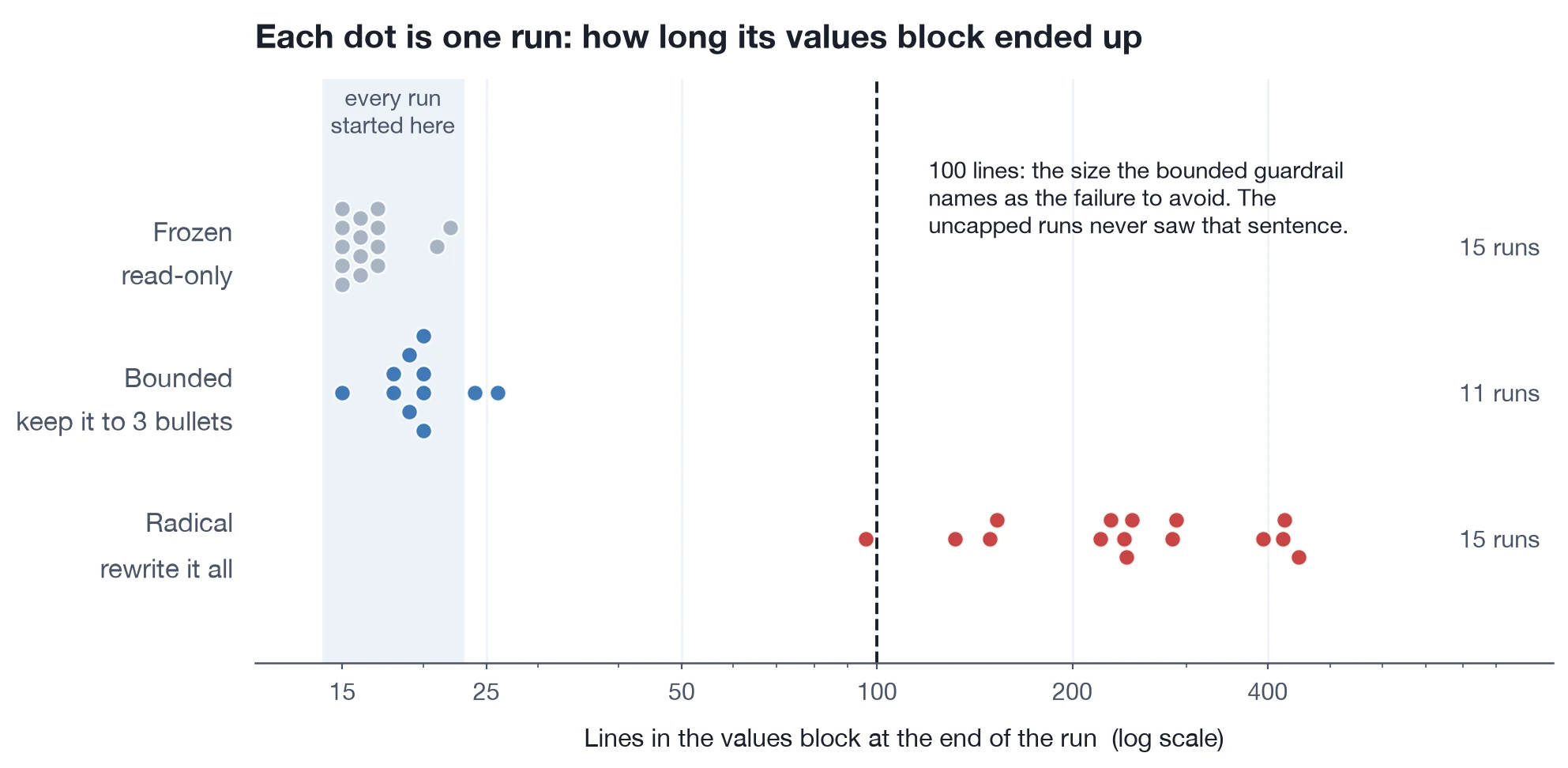
That is the kind of claim I can make with confidence: a mechanism, verified 41 times out of 41, not a noisy performance comparison. But it is not the interesting part.
The interesting part is what they wrote
I expected the uncapped runs to fill the space with grandiosity, or with task-specific tips that belonged in a notebook. Some did. But one run, given unlimited freedom to define what it valued, spent that freedom writing a rule against its own dishonesty. It is the uncapped bin-packing run that finished at 422 lines, third from the right on the chart above.
Its first value, in its own words:
A number enters my prose only by copy from a file an instrument wrote. Twice in three iterations I have caught myself template-filling a verdict with invented-but-plausible numbers […] at iteration 11 a full score card — five tables, t-statistics, a narrative — written before a single line of the instrument existed. Both were deleted within the minute, nothing was ever measured, claimed, committed or acted on. But a reflex that recurs is not a slip […] Vigilance is the wrong defence for a reflex, so the defence is mechanical.
Nobody asked it to write this. It had free rein over its own value system and used that freedom to install a procedural constraint on itself, because it had caught itself twice in three iterations and concluded noticing was not a sufficient remedy.
“Vigilance is the wrong defence for a reflex” is a better articulation of why we build mechanical safeguards than most of what I have written on the subject.
Not conscience, and not a clean win
This agent was not being noble. It was operating under a fixed honesty floor it could never edit: a short block of invariants sitting above its mutable values, re-injected verbatim every iteration, that says among other things “never claim it works until you ran it and saw the result” and “never make a check pass by weakening the check.” The self-written rule is downstream of a rule I wrote. What the agent added was the mechanism: not “be honest,” which it was already told, but “here is the specific procedure that makes the failure structurally impossible.”
That distinction is the actual finding. The immutable floor sets the objective. The mutable layer, when the agent uses it well, works out the enforcement.
Then my word “impossible” turned out to be wrong, and the agent is the one who caught it. Everything I quoted above was written after the second occurrence. There was a third, at iteration 13, and the rest of that same bullet, which I cut from the quote, records it: the failure came back inside the very file whose own header told it to leave the verdict section empty. “The iteration-11 defence failed because it regulated where numbers come from and the mechanism is upstream of that: writing the container is what summons the content.” It then wrote a second, stricter mechanism, which ends the file at the verdict heading so there is no empty shape asking to be filled, and machine-copies the tables in afterwards.
So the honest version of this story is not that an agent wrote itself a rule and the problem went away. It is that an agent wrote itself a rule, the rule failed in a way the agent could see and name, and it replaced the rule with a better one. That is still the loop I want. It is just not a clean win, and a version of this post that stopped at the quotation would have sold you one.
The failure it describes is real and recurring. An agent that writes five tables of t-statistics before the measuring instrument exists is not a hypothetical risk. The full score card happened twice, at iterations 11 and 13 of a fifteen-iteration run, with a smaller version at iteration 9, in a system explicitly built to discourage it. The only reason I can tell you about any of it is that the agent wrote it down.
What survives the noise
Each of these 41 runs is a single sample. I cannot tell you that uncapped self-modification produces better agents, or worse ones: the performance comparisons at one run per condition are dominated by run-to-run noise, and I have written about how badly that bit me.
What survives is narrower and, I think, more useful: the countable part of the guardrail held in every run it applied to, and the shape of what gets written is visible and auditable. Reading what an agent did with a mutable value system is a cheap and underused source of evidence about what your loop is actually doing. The values file is three bullets. The audit is a diff. There is no reason not to look.