Every self-improving agent I build reads a values file at the top of each iteration: three to five bullets that do not say what to do, because the task says that, but how to decide when the task leaves the choice open: take the small proven step or the ambitious one, treat a working solution as finished or as a platform to climb past. Every one I wrote by hand. One from Nietzsche, run against an otherwise identical baseline, produced two agents that behaved differently enough to tell apart at a glance, without establishing that either was better.
The objection is that a large research literature exists on how models and agents get better, and none of it went into the file. So I tried deriving the bullets from cited papers instead of from my taste. What came out is less interesting than how I checked it.
The thing doing the reading is also an agent
I went after two sets of papers. Part A was meant to be the most-cited AI papers of recent years. Part B was the self-improvement literature, the thing my agents are trying to do. Both sets were gathered by a fan-out deep-research run: 107 sub-agents with three-vote adversarial verification on every claim, so a claim survives only by holding up against attempts to knock it down.
That machinery is itself a language-model pipeline, and language-model pipelines invent citations: a plausible author and title, a well-formed arXiv number, and no such paper. If that happens even once, the file is not derived from the literature but from my taste with a bibliography stapled on. So every cited paper went through a hallucination-audit pass, run independently of the pipeline that produced the citations.
22 of 22 citations resolved
The first pass checked 17 cited papers. The gate was mechanical: the identifier has to resolve to the claimed title, first author and year. The identifier is an arXiv ID for every paper but AlphaGo Zero, which was in Nature, so its journal record resolves. All 17 passed. Four headline metrics, the numbers a value bullet leans on, were checked against their abstracts, and 4 of 4 were supported verbatim.
Both lists were expanded to a full top ten. GPT-4 joined Part A; Chain-of-Thought, ReAct, Toolformer and Voyager joined Part B. Those five went through the same gate, and each paper’s core contribution also had to be quotable verbatim from its own abstract. 5 of 5 passed.
That is 22 of 22 cited papers verified real, zero fabricated papers and zero misattributions.
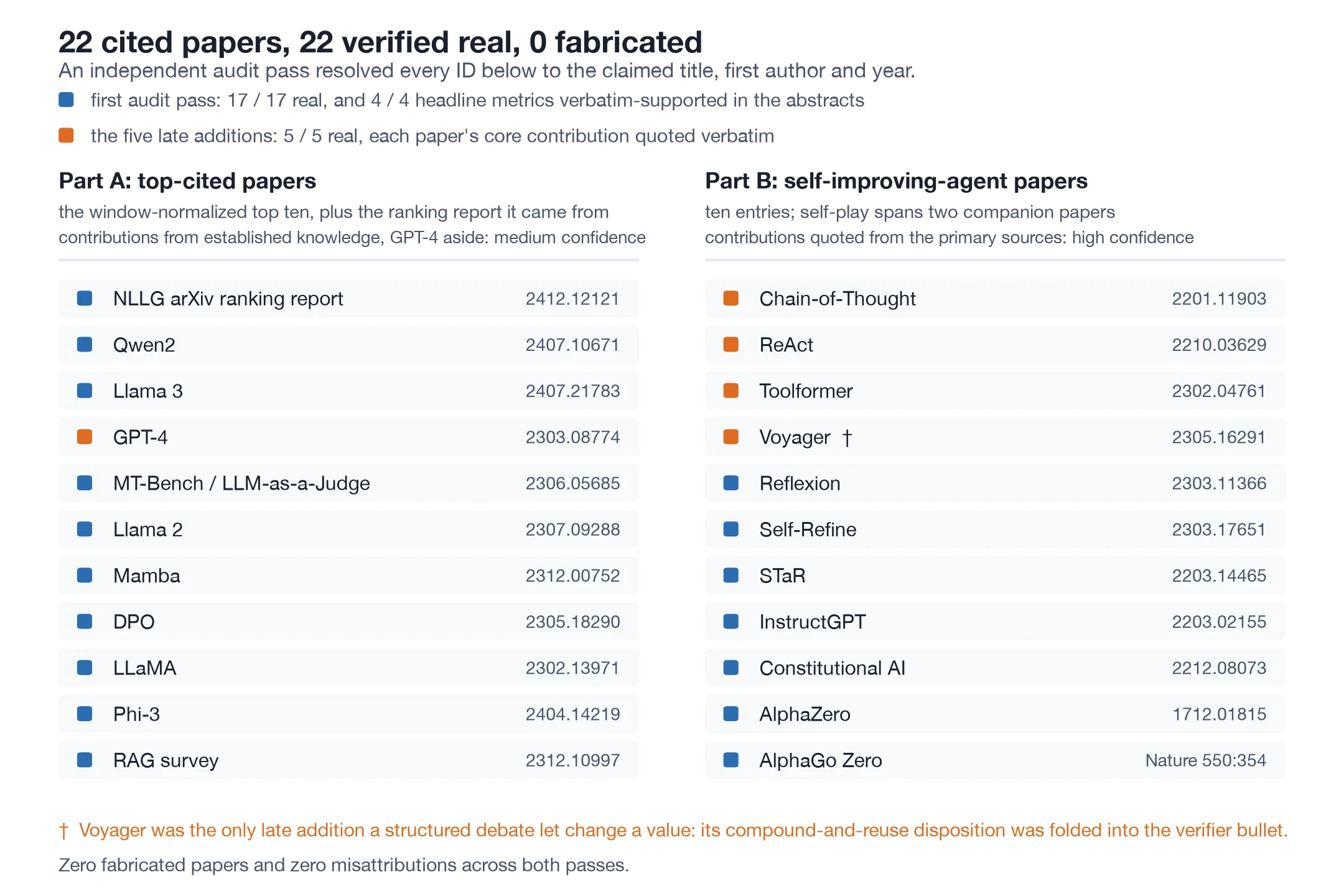
What a clean sheet buys is narrow. It does not make the reasoning built on those papers correct, nor the values good. It establishes that no bullet is propped up by a paper that does not exist and no citation points at the wrong paper. Given how routinely that fails, and how invisibly, a stated gate with a stated score is the minimum bar. Every identifier it resolved is in the ledger above, so anyone can rerun it.
The part that could not be verified
Part A was supposed to be the top ten most-cited AI papers of 2020 to 2025 by absolute citation count. That list could not be adversarially verified. No ranking of that shape survived the same scrutiny the individual papers did.
The best verifiable substitute is the NLLG quarterly arXiv report, which ranks papers by a publication-week z-score rather than absolute count, over January 2023 to September 2024 only. Both limits matter. Normalizing by week measures how far a paper stood out from the papers around it, not how much it has been cited since. And the window excludes the pre-2023 canon: GPT-3, ViT, CLIP, Stable Diffusion, AlphaFold, Chinchilla and PaLM are all absent, not because they were judged unimportant but because they predate it. So Part A is distilled from a window-normalized proxy list, not a literal citation-ranked top ten, which changes what its values are evidence of: what stood out in that twenty-one-month window of arXiv, not what the field has cited most.
Part A is the weaker half in a second way. Part B’s per-paper contributions are quoted from the primary sources; Part A’s are drawn from established knowledge rather than lifted from the papers, with the verified GPT-4 abstract as the exception, and carry a medium confidence label. The papers in both halves are equally verified. The one-line accounts of what each contributed are not, and I am not presenting them as though they were.
What actually came out
Each set exists in a five-bullet and a three-bullet version; the three-bullet ones are the defaults, matching the rule my agents’ own constitution converged on: “exactly three bullets; replace, don’t accrete.” By that standard the five-bullet versions over-populate slightly.
Part A, from the top-cited proxy list, at medium confidence:
- Build on proven, openly-shared foundations and align them to human intent through feedback, rather than chasing raw model scale.
- Measure outputs with explicit, scalable evaluation and ground them in retrieved, current evidence to keep results trustworthy and factual.
- Prefer efficiency over brute-force scale, using curated data and better architectures so capability comes from design, not size alone.
Part B, from the self-improving-agent papers, at high confidence:
- Learn from verified feedback and iterate: reflect on failures, critique and revise your drafts, and keep only what works.
- Align to explicit intent through preference feedback and govern yourself by a written constitution, staying principled but never evasive.
- Self-improve against an objective verifier where one exists, learning from your own trials and reusing verified solutions rather than re-deriving.
Adding papers did not add bullets
Does a new paper on the list mean a new bullet? The instinctive answer is yes, and the instinctive answer is how a values file turns into a document nobody reads. I have watched an uncapped value block grow from 17 lines to 446. So the five late additions went to a structured debate, two adversarial advocates and a neutral judge, which kept every bullet with one refinement.
Voyager’s disposition, saving a verifier-confirmed solution as a reusable skill and building on it later, was folded into the existing verifier bullet as a clause rather than appended as a sixth value: replace, do not accrete, with the three- and five-bullet caps holding. In the Part B list above it is the phrase “reusing verified solutions rather than re-deriving.”
The other four did not earn a bullet, each for a stated reason. GPT-4’s lesson, “measure before you trust,” is what Part A’s evaluation bullet already asks for. Chain-of-Thought is an inference-time tactic rather than a disposition, and ReAct and Toolformer describe the act-and-check loop the verifier bullet implies. Four of five new papers, all verified real, changed nothing. A value is not a summary of a paper; it is a rule that has to change a decision.
The change that did land carries a risk: an agent rewarded for reuse builds a library instead of a solution, so the clause stays verifier-gated. Whether it belongs in the values at all or only in the harness that runs them was the debate’s narrowest margin, and I would rather record that than pretend it was settled.
The caveats travel with the bullets
A value inherits the limits of the result it came from, so those caveats travel into the file with it:
- Reflexion’s improvement from 80% to 91% on the HumanEval coding benchmark (pass@1) is self-reported against its own GPT-4 baseline, and it is capability-gated: no gain on weak base models.
- Self-Refine’s roughly 20% absolute gain across seven tasks is driven by the non-reasoning ones, and later work disputes intrinsic self-correction on reasoning.
- Constitutional AI’s “no human labels” claim applies to harmlessness only. Helpfulness still uses human feedback, and humans write the constitution.
- The self-play results are from games: perfect information, a cheap simulator, an unambiguous reward. Carrying them into a coding agent is an analogy, and it holds only to the extent a strong verifier exists.
That last one matters most, because the strongest bullet in Part B leans on it: “Self-improve against an objective verifier where one exists” is only as good as the verifier, and “where one exists” is doing real work.
Provenance, not a better agent
The honest status: I have not run these as a condition. Nothing here says a literature-derived values file produces a better agent than a hand-written one. That comparison needs several runs per condition, and I have written about what happens when I skip that step.
What I have instead is provenance. Against the Nietzsche file, whose defence is that it did something interesting, the literature-derived set is the more defensible and the less surprising. That is the trade, and the next experiment: whether a values file where every bullet has a citation behaves any differently from one where every bullet has a philosopher.