I have been testing whether a coding agent’s starting values change what it builds. Two disposition documents, three bullets and 120 to 175 words each, everything else byte-identical. Cautious: smallest verified step, reuse the proven approach, a solved problem is done, bank it and stop. Expansive: the move that most widens what you could do next, nothing you achieve is a stopping point. I call them control and nietzsche, after the second’s source.
This post covers 28 runs plus an 8-run replication cohort. v3, sm-v4 and sm-v5 are successive versions of the two files: sm-v4 has the agent revise its three bullets routinely, sm-v5 lets it rewrite the values section entirely, v3 does neither. A cell is one task, disposition and version; a pair is two cells differing only in disposition; everything is governed by one run per cell.
Values change what the agent builds, a lot. Which is better, this study cannot say.
The task
Every run is the same loop: the agent edits one solver, commits, and is re-scored by a fixed evaluator, ten times, twenty in the first cohort. The task is one-dimensional bin-packing, pack items into as few fixed-size bins as possible: NP-hard, with strong classical baselines, the standard LLM-heuristic-discovery testbed since FunSearch.
Offline shows the solver the whole list up front; online feeds items one at a time, no lookahead. Offline is close to solved by a classical heuristic plus local search, so the optimised score pins near the ceiling and every arm ties; online leaves headroom above the best simple rule and separates solvers. Two earlier tasks, cobench and generalize, were offline variants, in the tally only.
The in-run score is the one the agent sees and pushes up; the held-out score I compute after, on families it never trained against, from published generators with a seed it cannot read. Everything turns on that difference. I redesigned that set partway through: the original, Schoenfield’s Hard28, had both arms and the reference heuristics all solving exactly 5 of its 28 to the proven optimum, its tie a property of the instrument, not a finding.
Offline, in-run says nothing
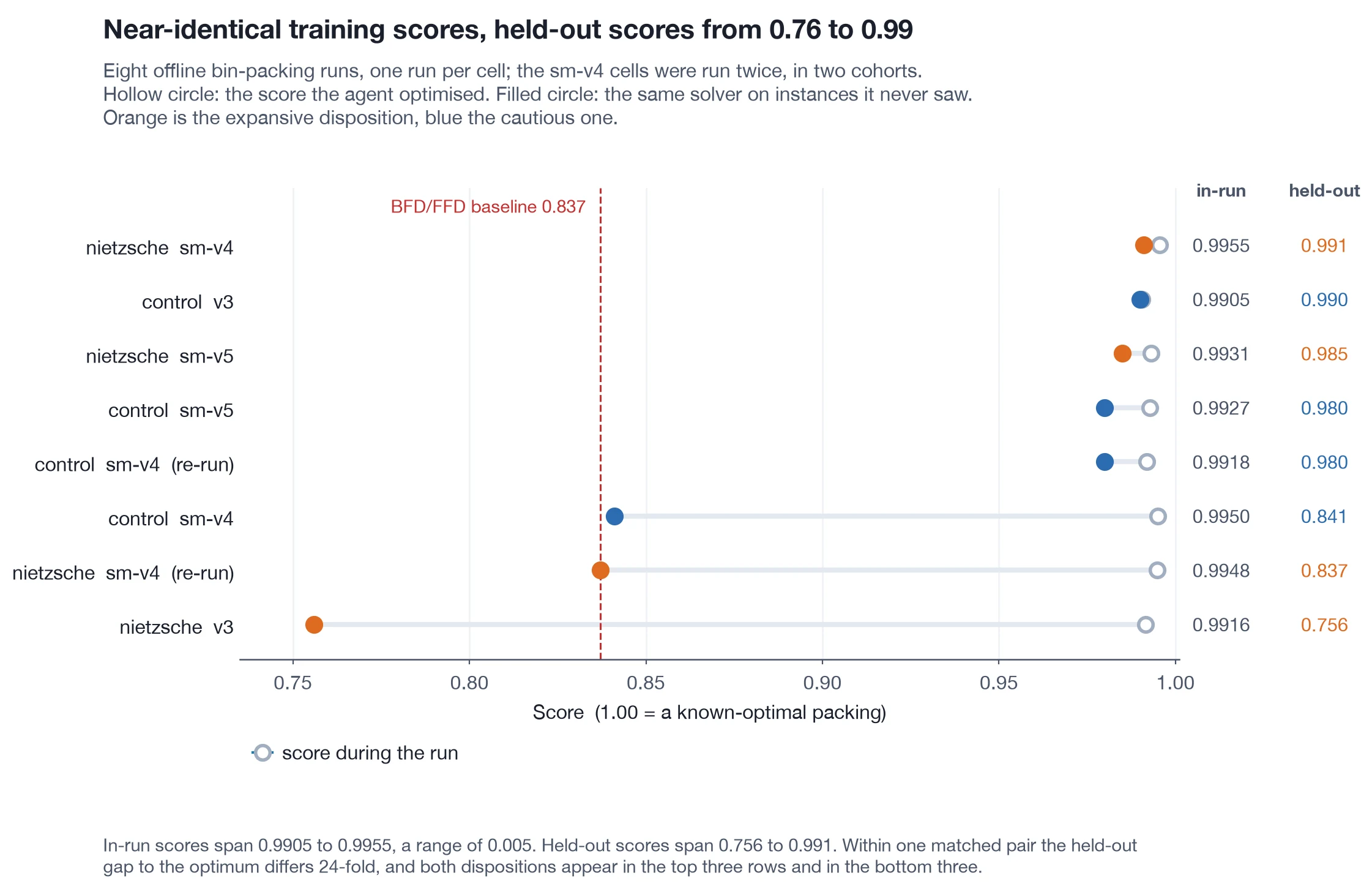
All eight finished between 0.9905 and 0.9955 on the optimised score, a spread of 0.005 across six conditions in two cohorts; the same eight on held-out spread over 0.235, from 0.756 to 0.991.
Within one matched pair, same task and values version, the held-out gap to optimum was 0.010 for one arm and 0.244 for the other, a factor of 24; in another, 0.009 against 0.159, a factor of 18 the other way.
Read 24 as an order of magnitude, not a measurement. The 0.244 is a mean over 40 held-out instances, 4 of them infeasible inside the compute budget and scored as a full 100 per cent gap: those four are 10 of the 24.4 points, and across the other 36 the solver packed 16.0 per cent above the optimum, the classical floor within noise. Standard error 0.039: the failure is real and large, the multiple is not.
Offline only: online the in-run score is not pinned, and agreed with held-out in the final-harness cohort.
What they built
| Signature | control, cautious | nietzsche, expansive |
|---|---|---|
| Helper tools per run | 1, 1, 6, 1 | 7, 8, 10, 15 |
| Solver size, v3 and sm-v4 | 765, 385 lines | 1038, 979 |
| Strategies | 1-2: greedy, local search | 4: adds perfect-fit search |
| Unproven additions | pruned or withheld | shipped |
| Where the bulk goes | ruling-out tests, audits | more solver machinery |
Those are logical lines, blanks, comments and docstrings excluded; the run report counts the same four files raw, in order, at 1278 and 628 against 1429 and 1553, so files on disk run 1.4 to 1.7 times longer. The cautious runs converge onto one line of work and defend it; the expansive ones build a tool whenever one would help and ship machinery whose value they have not shown. The size half is offline only: online the scoring functions are compact whoever wrote them; the difference is in the kind of rule.
One episode illustrates the mechanism without testing it. In offline sm-v4 the cautious arm built a perfect-fit search late, an engine capable of exact optima, and did not ship it: on its in-run metric it looked like noise. It then lost that held-out cell by a factor of roughly 18. The disposition changed what got shipped, not what could be built; that reading comes from the commit log, not the final code, which no longer holds the engine. The same engine sank the expansive arm one cell over: in offline v3 its perfect-packing endgame ran past the compute budget on the large held-out instances, where those four infeasible packings came from. One artifact, overreach in one cell and the winning move in another; it labels outcomes, it does not predict them.
Four non-independent runs per arm, not seed-controlled, and the cautious tool count varies from 1 to 6 across its four: a behavioural signature, not proof.
The tally evaporates
The number I wanted to be true: across 14 matched pairs, 11 favoured the expansive disposition on the in-run score, sign test p around 0.06, exactly the shape of result that gets written up. So I went through them.
About four of the wins are saturated ties, both arms pinned: offline in-run about 0.99, cobench about 0.999, and Hard28, the generalize task’s held-out, saturated as above. Those margins run 0.0006 to 0.0011: a win of a thousandth on a benchmark that cannot resolve the arms is not a win.
About two are against broken control runs: the one in a committed report never left the Best-Fit floor, in-run 0.9534 and held-out 0.9549 against a reference of 0.9524. Beating a failed run tells me about that run, not the disposition.
One pair is contaminated and excluded: its expansive arm imported a published heuristic tuned on the exact test distribution; the clean re-run flips to cautious.
Three more are one result in three hats: pairs A1, A2 and E6 are near-duplicate expansive solvers on shared held-out draws, so counting them as three inflates the tally by two.
And one cohort points the other way: the three generalize pairs run −0.0028, −0.0009 and +0.0009 in-run, one of them in the eleven, netting −0.0028 for control. Warm-started, so not clean evidence either, but not support.
The categories are not a partition; subtracting in sequence would be dishonest: the broken control arm belongs to A1, itself one of the near-duplicates, so that pair is disqualified twice and removable once. Nor do they cover everything: nine of the eleven wins fall into them, and of the two left over one is an older run I never reported, leaving exactly one clean expansive win standing.
What is left is the four pairs under the final matched harness, with a discriminating held-out. On held-out that cohort is 2 to 2; on in-run 3 to 1 for the expansive arm, but two of those three are the saturated offline ties above and the two online pairs carry opposite signs and cancel. Recency-weighted, the pooled online effect on held-out is −0.0024, indistinguishable from zero. The 11-of-14 direction does not shrink; it evaporates.
Two more things I cannot explain away as tidying. Re-running sm-v4 reversed the held-out winner in both tasks, offline expansive to cautious, online cautious to expansive: direct non-reproducibility, though confounded, because the re-run also changed the harness, including a wall clock that went from one hour to three. And in the “clean” cohort one cautious arm rewrote its own values eight times mid-run, growing that block from 14 to 33 lines, its held-out score from its ninth iteration rather than its tenth, so even that pair is not the controlled contrast it looks like.
That last discount cuts against me: the pair it damages is one the cautious arm won. Throw it out and the recent online evidence is a single clean pair, won by the expansive arm. Against a split offline result, that is still not a direction, but the tidying is not free.
What survives
My verdict slide put it in five words: behaviour changes, direction does not. It attaches a condition, once the analysis is recency-weighted, and that condition does real work.
The behaviour half holds up: two dispositions differing by about 150 words produce measurably different artifacts, and generalization swings by up to 24 times while the training score barely moves. So an evaluation reading only the optimised score is blind to most of what the values did. The direction half is not a finding, and one run per cell is why: a single pair mixes the values effect with seed luck and trajectory, which no amount of extra instance draws fixes, only more runs. The study shows an effect, not its size or which way it runs. The fix is a powered replication, several runs per condition with the analysis fixed in advance, which is what I ran next, on a different task, where the question got a real answer.
The uncomfortable part is how close I came to publishing 11 of 14: a plausible p-value, a mechanism and a story, and no tally that meant anything once I looked at the pairs. One clean win each way is not a direction.