If you build a system that writes long-form answers, you have a measurement problem. There is no accuracy score for “was this a good piece of research.” So the field has largely settled on a workaround: ask a language model to grade the output.
This is convenient and obviously suspicious. The graders are the same class of system as the things being graded, and often literally the same models. So when we evaluated Caesar, our research agent, we used a panel of three judges from three different families: Claude Sonnet 4.5, GPT-5.2 and Gemini 3 Pro. Then we went looking for the failure mode everyone worries about: a judge favouring its own family.
We found it. Then we found out that the way we measured it cannot distinguish that failure mode from something much more boring.
The scoring setup
Every answer was scored on three dimensions, each 1 to 10: New, Useful and Surprising. Those sum to a 30-point total, and every number below is in points on that total.
Seven systems were graded. Six of them are the three judge models themselves, each run twice: once in the vendor’s own autonomous research mode (“deep”), once with ordinary single-step web search (“shallow”). The seventh is Caesar, which runs on GPT-5.2. Each system answered five research challenges under three output formats: an unconstrained full answer, an unconstrained explain-it-simply summary (our paper calls this ELI5, for “explain like I’m five”), and an ELI5 summary capped at 450 words. Every judge scored every answer three times.
Measuring a judge’s favouritism
The test is simple. For each judge, take the two baselines that carry its own model name, and compare the scores that judge gave them against the scores the other two judges gave the same answers. If a judge is neutral, those should agree.
On full-length answers:
| Judge | Its own family, minus what the other two judges gave |
|---|---|
| Gemini | +1.35 |
| Claude | +0.98 |
| GPT | −0.82 |
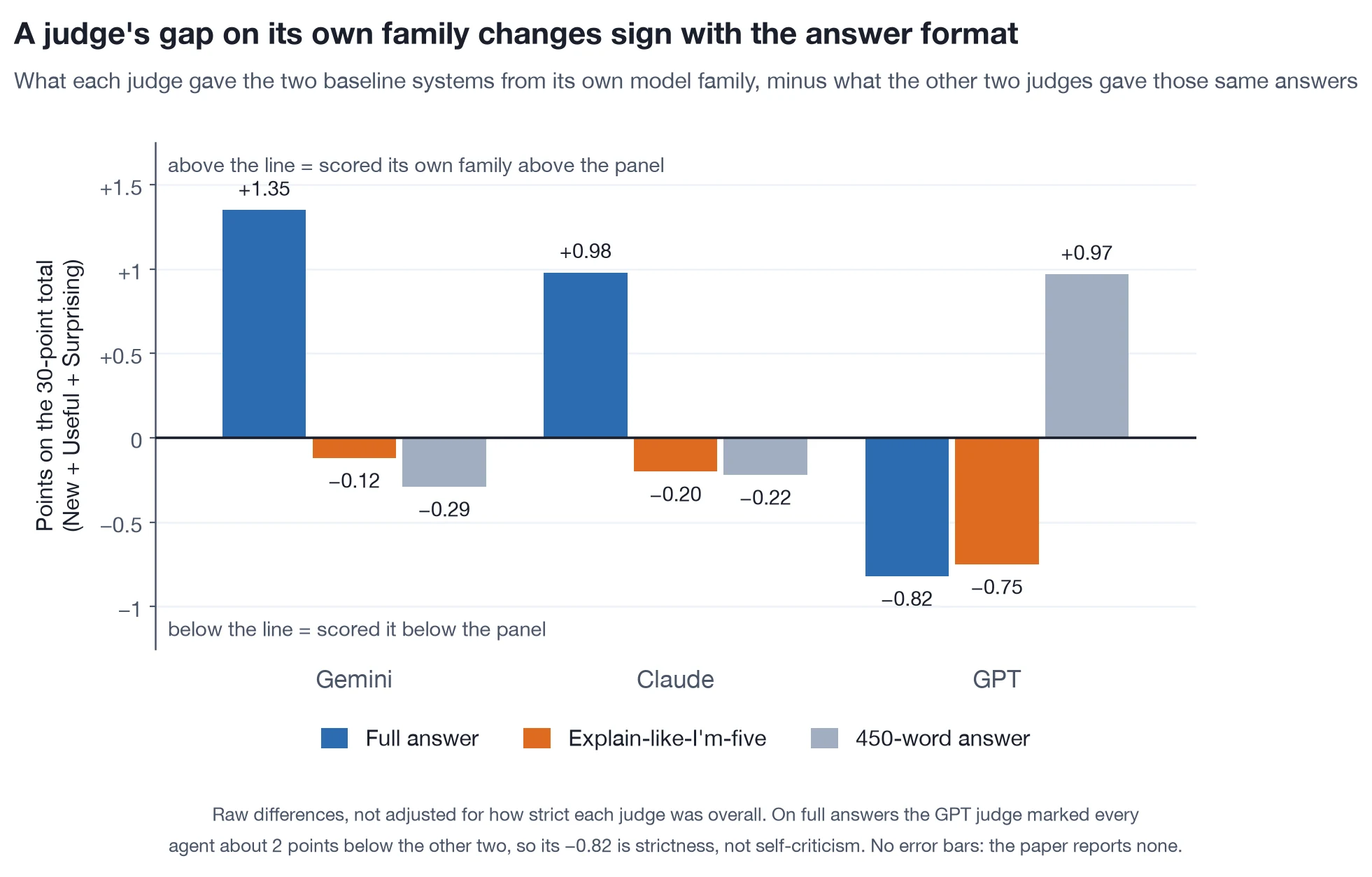
The Gemini judge scored its own family 1.35 points above what its colleagues gave the same text, Claude +0.98. On a 30-point scale 1.35 is 4.5%: small in absolute terms, and still large enough to matter, because the gap between Caesar and the strongest baseline (Gemini 3 Deep Research) was 3.18 points on that same scale.
Two things belong next to that table. There are no error bars: each cell is a difference of two means, and the paper reports no interval and no significance test for any of them. And Caesar is not counted in the GPT family, even though it runs on GPT-5.2, so none of these numbers say anything about how the GPT judge treated our own system. The family groups are the six named baselines and nothing else.
The GPT row does not mean what we said it meant
The GPT judge looks like it went the other way: −0.82, harsher on its own family than the other two judges were. We originally read that as a nice result, a counterexample showing self-preference has no universal direction.
It is not that. The number is a raw difference of means, and it does not control for how strict a judge is in general. A judge that marks everyone down will look unbiased toward its own family only if it marks its own family down by the same amount.
You can check this from the paper’s own tables without any new data. Table 1 gives each agent’s score averaged over all three judges; the robustness table gives the same agents averaged over Claude and Gemini only. Two equations, one unknown: the GPT judge’s own column falls straight out. Doing that reproduces the published −0.82, −0.75 and +0.97, one per answer format, to within rounding, which checks the reconstruction.
It also shows this. On full answers the GPT judge marked every agent about 2 points below the other two, and the agents outside its own family about 2.5 points below. Against its own family it was only 0.8 points below. Measured against that 2.5, the GPT judge marked its own family up by about 1.7 points. The same correction gives +0.1 on ELI5 answers and +2.0 on 450-word ones. Never negative.
So the honest statement is not “this judge dislikes itself.” It is that our bias metric mixes self-preference with overall strictness, and for the one judge where we can pull those apart, doing so flips the sign. The paper publishes no Claude-only or Gemini-only column, so the same correction cannot be computed for the other two judges. Their +1.35 and +0.98 could be bigger or smaller than they look, and we cannot say which.
The gaps move with answer format
Whatever these numbers are measuring, they are not a property of the judge alone. They are a property of the judge and the task.
Ask for an ELI5 summary instead of a full-length answer and the Gemini and Claude gaps land at −0.12 and −0.20. That is a disappearance, not a reversal: on a 30-point total those two values are not distinguishable from zero, and calling them “negative” would be reading noise. GPT is the one that reverses rather than fades, from −0.82 on full answers to +0.97 on 450-word ones.
So a single number for “this judge’s bias” would be the wrong shape of thing to report. But the evidence for the format effect is thin and should be described that way: nine numbers, one per judge per format, from a single evaluation run, with no error bars on any of them.
The verbosity trap, and why the obvious fix is wrong
The other standing worry about LLM judges is that they reward length. We checked, and at first glance the worry looks confirmed: across all seven agents, the correlation between answer length and score is r = 0.47. The paper calls that moderate, which is the right word: it is about 22% of the variance in score.
Then we restricted the comparison to the deep research tier, Caesar and the three vendor research modes, which produce answers of comparable length. The correlation went to r = −0.13.
This is Simpson’s paradox. The overall correlation is real, but it is generated by between-group differences: the systems that write longer answers happen to also be the ones that write better ones. Inside the deep research tier, extra length buys nothing. If we had stopped at r = 0.47 and “corrected” for verbosity, we would have adjusted away a genuine quality signal.
The limit on that claim is that we only ran it inside one tier. “Length buys nothing among peers” is established for the deep research group and untested for the shallow one.
What we did, and why it is not enough
Two things, neither of which fully solves the problem.
We report the panel rather than a single judge, so no one model’s thumb decides the outcome. And because Caesar is built on GPT-5.2, creating an obvious circularity, the paper also reports every agent’s total with the GPT judge dropped. The ranking held, in all three formats, all seven positions.
What “the ranking held” does not tell you is what happened to the size of the win. On full answers, Caesar’s margin over the runner-up falls from 3.18 points with all three judges to 1.74 with the GPT judge removed. The order survives; 45% of the margin does not. The other two formats move much less, 3.82 to 3.34 and 4.73 to 4.07, but the headline number is the one that moves most. And the two judges left standing include the Gemini judge, the one carrying a +1.35 thumb on its own family, a group that includes Gemini 3 Deep Research, the exact system Caesar is being measured against. Neither the three-judge margin nor the two-judge margin is clean.
That is a robustness check, not a fix. It is also a re-aggregation of scores we already had, not a fresh evaluation run: it tests whether the GPT judge was carrying the result, and nothing else.
The honest position is the one in our paper’s limitations: LLM-as-judge “remains an imperfect proxy for human creativity assessment,” and judges trained by similar procedures may share blind spots that no panel of them can detect, because the panel is not independent in the way the word implies.
Which is why we also asked actual humans.
If you are using LLM judges
Four things this experiment would suggest, none of them expensive:
Measure the bias rather than assuming it. One extra analysis pass found a 1.35-point thumb on the scale.
Then work out what your bias metric is confounded with. Ours was a raw difference of means, which cannot separate self-preference from a judge being strict with everybody. Pulling those apart reversed the sign of one of our three headline numbers.
Measure it per output format. Ours moved a lot between long and short answers.
Check whether your confounder is between-group or within-group. Our verbosity correlation was 0.47 across all agents and −0.13 among deep research peers. The naive correction would have made the evaluation worse.