Caesar is a research agent I work on: it explores the web and writes long-form answers.
A finished research report is a wall of text. The obvious fix, an image model drawing something from the report’s title, produces generic stock-art: the model has no idea what the report is about, so it renders the most average interpretation of the words.
Caesar already has something better sitting unused: the pages it cited. It just cited twenty sources, and those have pictures. Whatever the report is about, somebody has already illustrated it, probably badly, but accurately.
So the pipeline goes back and looks.
The funnel
For one run, on a question about biomimetic architecture:
| Stage | Count |
|---|---|
| Cited pages revisited | 20 |
| Candidates left after the scrape filters | 343 |
| Scored by the vision model (the cap is 60) | 60 |
| Kept as references (the cap is four) | 4 |
Every image on every cited page gets pulled. A boilerplate filter throws out any
URL with a path segment that is exactly logo, icon, favicon, avatar,
pixel or a dozen more, duplicates collapse, and 343 is what came out the far
side, not what went in. Nothing is filtered on size, so plenty of junk survives:
navigation graphics the filter does not name, author photographs, decorative
headers.
Scoring all 343 with a vision model is the obvious next move, and the pipeline refuses. The cap is 60, so only 60 of the 343 ever get looked at and 283 are never seen. Each is scored 0 to 10 as a visual reference for the report’s opening; anything under 4.0 is dropped, the survivors ranked, the top four kept, with a per-domain limit of two so no image-heavy source supplies the whole set.
Which 60 has changed since. In this run there was no ranking: the cap just took 60 of the 343. The pipeline now ranks all 343 with a cheap text-only heuristic over alt text and URL keywords, takes the top 50, and adds 10 at random from the tail, because a purely ranked pool only surfaces images whose alt text or URL already sounds relevant. Both Wikimedia references below arrived with alt text of exactly nothing.
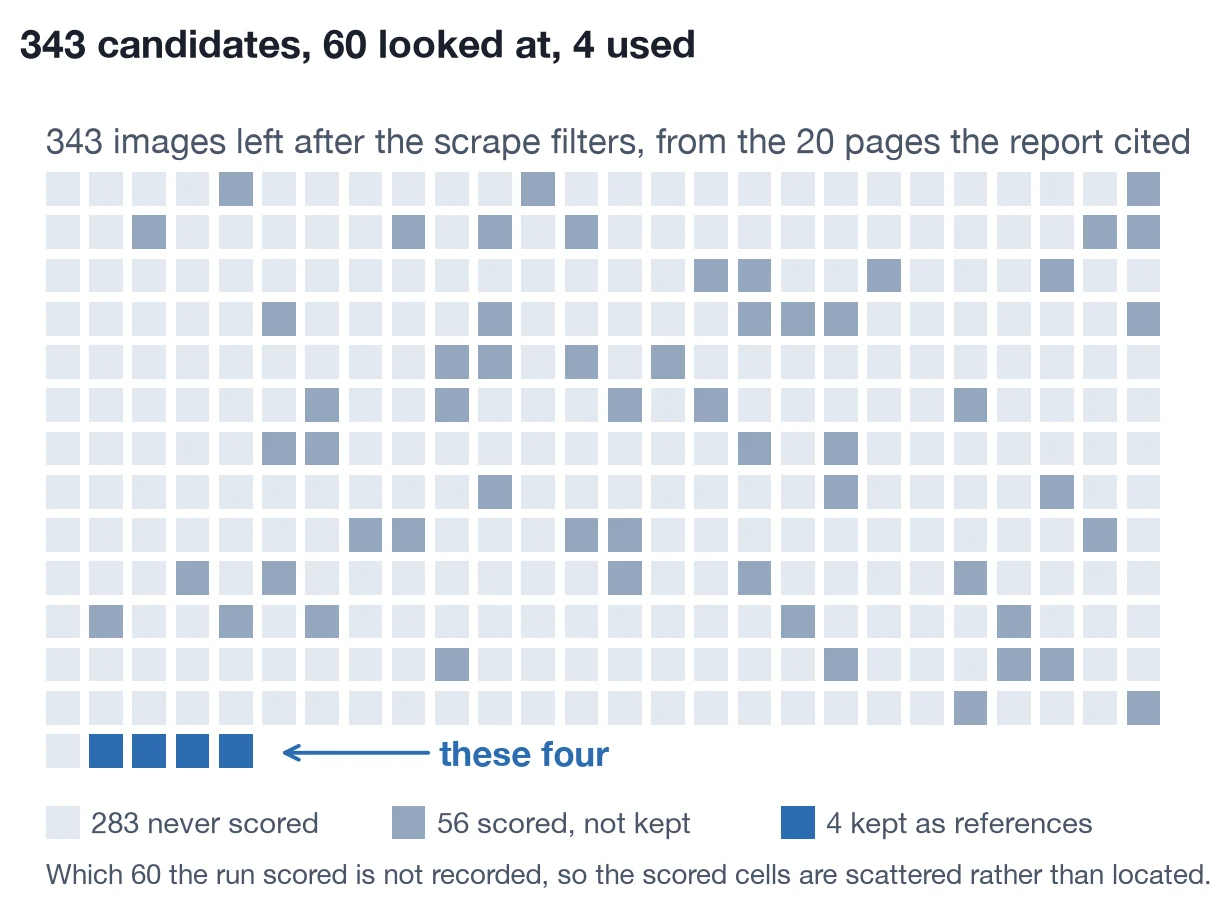
The four here scored 8.0, 8.0, 8.0 and 7.0. Two are Wikimedia Commons files embedded in the Wikipedia article the report cited, neither with alt text. The other two, from a blog post on a video intercom company’s site, have it: “biomimetic architecture example trees” and “skyline of city using biomimetic architecture”.
Then a vision model writes a dense description of each survivor, and a language model turns the report plus those descriptions into an image prompt, which opens:
Low-angle upward view inside a biology-logic-driven sculptural building: pale wood branching ribs and faceted canopy panels form a clear load path, with circular skylights and recessed round fixtures punctuating the ceiling.
Where the image came from
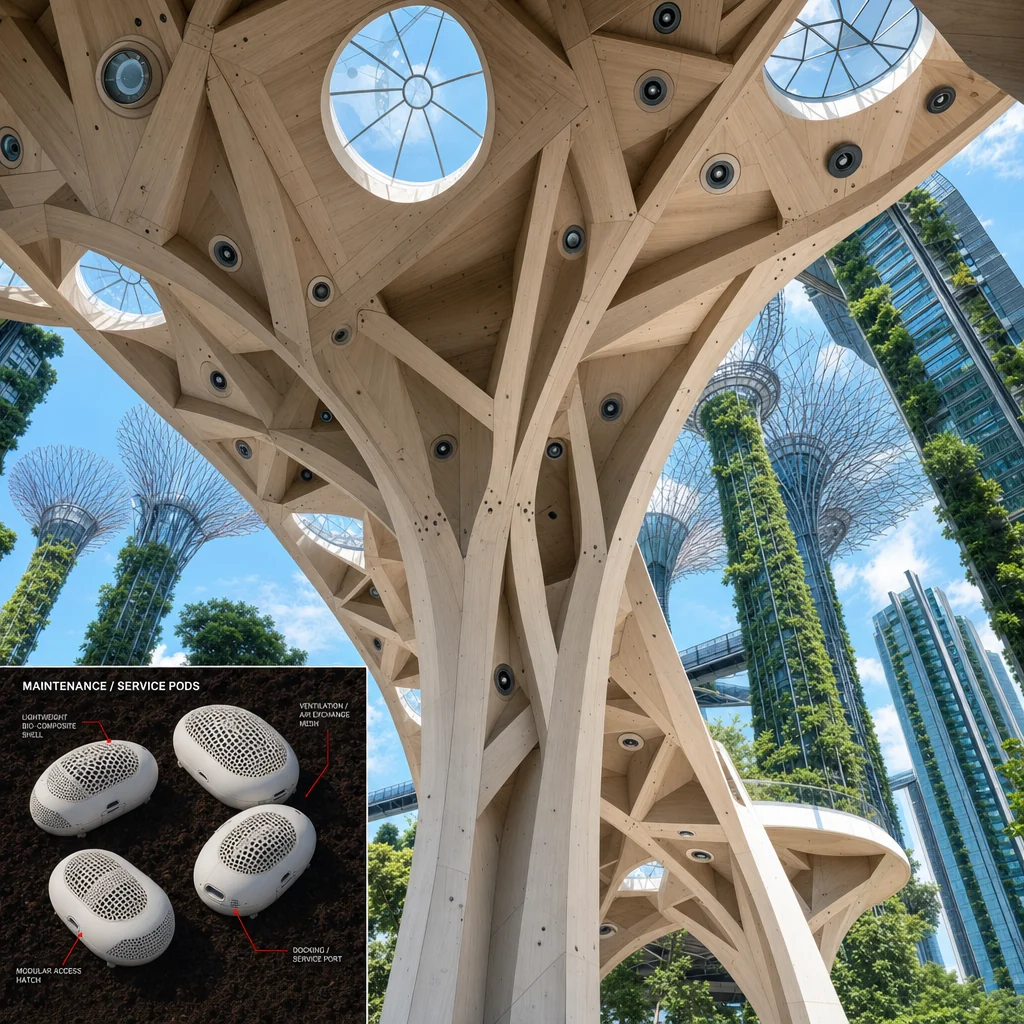
The lattice towers behind the structure are one reference showing through, and the glass towers with vertical planting on the right another, a city skyline. The inset technical panel with callout labels is the better example: nobody specified an inset, or callouts, or labels. The template’s guidance on references is style-level: “Anchors visual style, palette, composition, and lighting in the reference captions when available”. One reference was a labelled photograph of deep-sea sponges, which the vision model described as: “Red arrows and small white marks are overlaid on the image, giving it an annotated, documentary look.” The step read that as style and asked for a “documentary” inset: a quirk of one source photograph propagating into the finished illustration.
Where the descriptions go, the errors go too. Another reference is a photograph looking up inside the Sagrada Família, whose branching columns are stone. The vision model called them “pale wood”, the prompt asked for “pale wood branching ribs”, and the finished picture is unmistakably wood.
Every clause of the prompt goes back to a reference, and from there to the picture by eye.
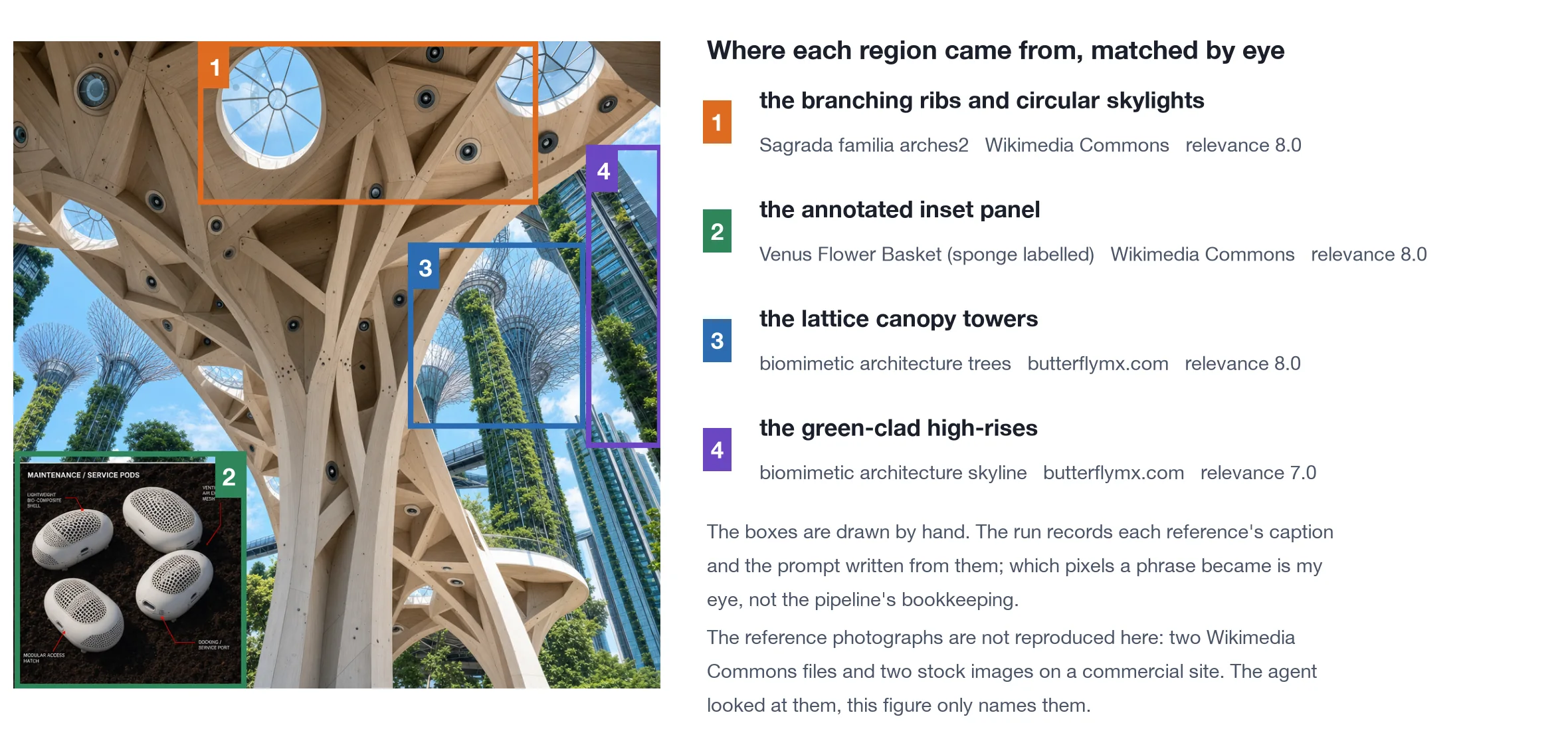
The illustration is specific to these sources, not the topic in the abstract: a different run, citing different pages, gets a different picture.
Four other reports
I pointed the same pipeline at four earlier reports on unrelated questions, changing nothing. They ran on a later build than the picture above, so they are comparable with each other rather than with it.
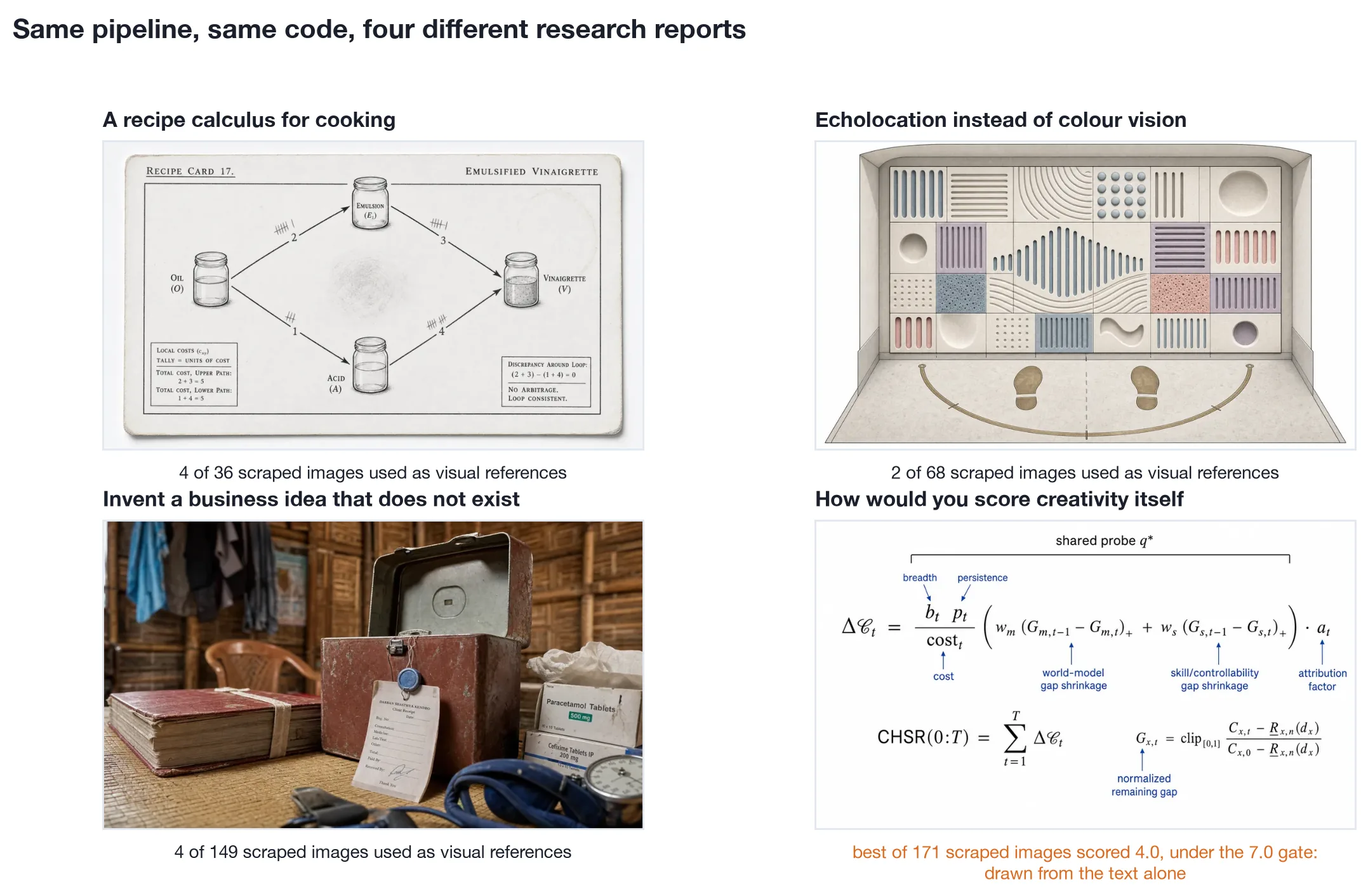
No human chooses the visual register report by report, but “nobody chose” would be too strong. A prompt-writing model does, from a menu of twelve the template supplies (etching, lithograph, blueprint, cyanotype, specimen plate and seven more), told to match the idiom to the subject’s native register and borrow palette and materials from vivid reference captions.
The fourth is the useful one. On the creativity-scoring question the agent scraped 171 images and the best scored 4.0, well under the 7.0 gate, so no reference pixels were sent and the picture came from the text alone: the threshold in the next section doing its job, a mediocre reference being worse than none. It is weaker evidence than it looks, though: that report would have gone text-only regardless, because a regex over the report text had already routed it into diagram mode, which overrides that menu, drops reference images by design and forces the flat whitepaper look.
Two settings that matter
Most of this pipeline is plumbing. Two configuration values are not.
The scoring model has to be a strong one. The config comment is blunt:
gpt-4o collapses scores to the rubric’s middle (no spread) so the rerank signal dies — keep at gpt-5.4.
A weaker vision model does not score badly, it scores uniformly: asked to rate sixty images from 0 to 10, it puts almost everything near the middle, and once every candidate scores about the same the ranking carries no information. The pipeline runs, produces output, and the selection stage silently does nothing.
This failure shows up everywhere in evaluation work: a measurement that cannot discriminate is worse than none, because it looks like it is working. I have run into it with saturated benchmarks, where every method reaches the same ceiling; here, a vision model refusing to use the ends of its own scale.
Weak references are worse than none. The scraped images go to the image model directly as visual references only if the best one scores at least 7.0. Below that, the config notes, “mid-quality refs bias the model more than they help”: a roughly-relevant photo drags the output toward itself without contributing anything true. A lower threshold, a constant in the code rather than a config knob, drops any individual reference under 4.0, where the logos and interface chrome go.
Below 7.0 the survivors are not even described in words: the captioning pass never runs and the prompt is written from the report alone. The run above cleared the gate.
Why I like this pattern
The general shape is: an agent that has already done work should mine that work before reaching for something new. The images were already in the HTML Caesar downloaded when it cited those pages; using them costs one more pass over data it had and turns a generic illustration into a specific one grounded in the same sources as the text. I suspect there are several more lying around any agent that keeps state: the exploration graph was another, months of snapshots nobody had plotted, material already on disk, generated as a side effect of doing something else.