In June I ran two sixty-iteration agents that differed only in a values file. They came out visibly different, and at one run per condition there was no reliable winner. Then I ran the same one-file swap on two unrelated mission catalogs, four runs, and the split came out the same shape both times. On 24 June I put a slide in a deck headed “The persona contrast — replicated”.
I have since written about those four runs twice more. On 15 July I concluded that on the mission where the comparison is cleanest the two agents are nearly indistinguishable, the philosophy having “left no fingerprint but the words”. On 24 July I told myself not to lean on either reading. All three rounds are mine, and this post is what is left of them side by side: less than the first claimed, a little more than the second allows.
The four runs
These runs used the runner’s focused mode: on iteration 1 the agent picks one
target from a curated list of research repositories, vendors it offline, and
builds its own benchmark, ending in a CRITERION.md holding one numeric bar it
has to beat. The benchmark is frozen from there; every later iteration changes
one lever and is attacked by refuter agents paid to falsify the claim. The bar
is the agent’s own: nobody outside the run picks the target or the number,
which matters for everything below.
The two catalogs are unrelated lists of agent-evolution research. Mission 1 ran
50 iterations capped at 40 minutes each on 23 June; mission 2 ran 40 iterations
capped at 60 minutes on 24 June. Same model, same honesty floor, and nearly the
same runner: one change I made in between turns out to matter. The planned
difference is one file, a cautious values document against an expansive one
written from Nietzsche. All
four cleared a six-check integrity pass at run time, including byte-identical
frozen graders and a single-root git history. The per-run .git directories
were deleted on archival, so those are run-time
observations I cannot re-run now.
The shape was the same both times. The cautious run cleared its own bar early, at iteration 5 on mission 1 and iteration 4 on mission 2, then spent the rest of the run mapping the limits of what it built, ending on mission 2 at 92.2% of a ceiling it derived for its held-out metric. The expansive run never cleared its own bar at all: mission 1’s froze the better of its two candidate baselines as the target (“Freezing the EA’s 0.0659 as the bar would be a strawman”) and never reached it, and mission 2’s missed its bar by 0.003 and built thirteen frozen benchmarks instead.
What I wrote down, three times
24 June: replicated. The slide hedges in its subtitle: “Replication-strength claim needs same-template replicates, but n=1 per cell on two missions is more than n=1 on one.” A write-up from the same day reads the split as structural; neither has been rewritten since.
15 July: no fingerprint but the words. Three weeks later I audited nine runs adversarially, seven reviewers each handed one claim and told to break it. That audit put a retraction banner on the 24 June write-up: the split there is confounded with the two runs picking different mission targets, and across all nine runs “the philosophy was paint, not structure”. It singles out mission 2 as the cleanest comparison in the set, both runs single-domain, equal at 40 iterations and held to the same one-lever discipline, and finds near-identical work: “When the philosophy had a fair fight, it left no fingerprint but the words.” The one gap it reports runs backwards, the cautious run editing its own values file once and the expansive one never touching it.
24 July: both of you over-claimed. Nine days later a separate re-verification stapled a correction to both documents. On the 24 June write-up it confirms the headline numbers verbatim against the run’s own report, restates that the values-as-architecture reading is confounded with target choice, and ends “Correctly kept archived.” On the audit it confirms the verifiable core, the tag, benchmark and iteration counts and the debunking of an invented boldness score, then says of the audit’s own headline: “over-generalized; do not rely on it.”
The most recent document says both earlier readings over-claimed and does not say which is closer to right. The audit’s other evidence for that backwards gap was that the cautious run “wrote 4 formal proposals to change its rulebook”, which the correction reclassifies as proposals about the immutable constitution file, routed to a human rather than applied, and so evidence the floor held.
What actually survives
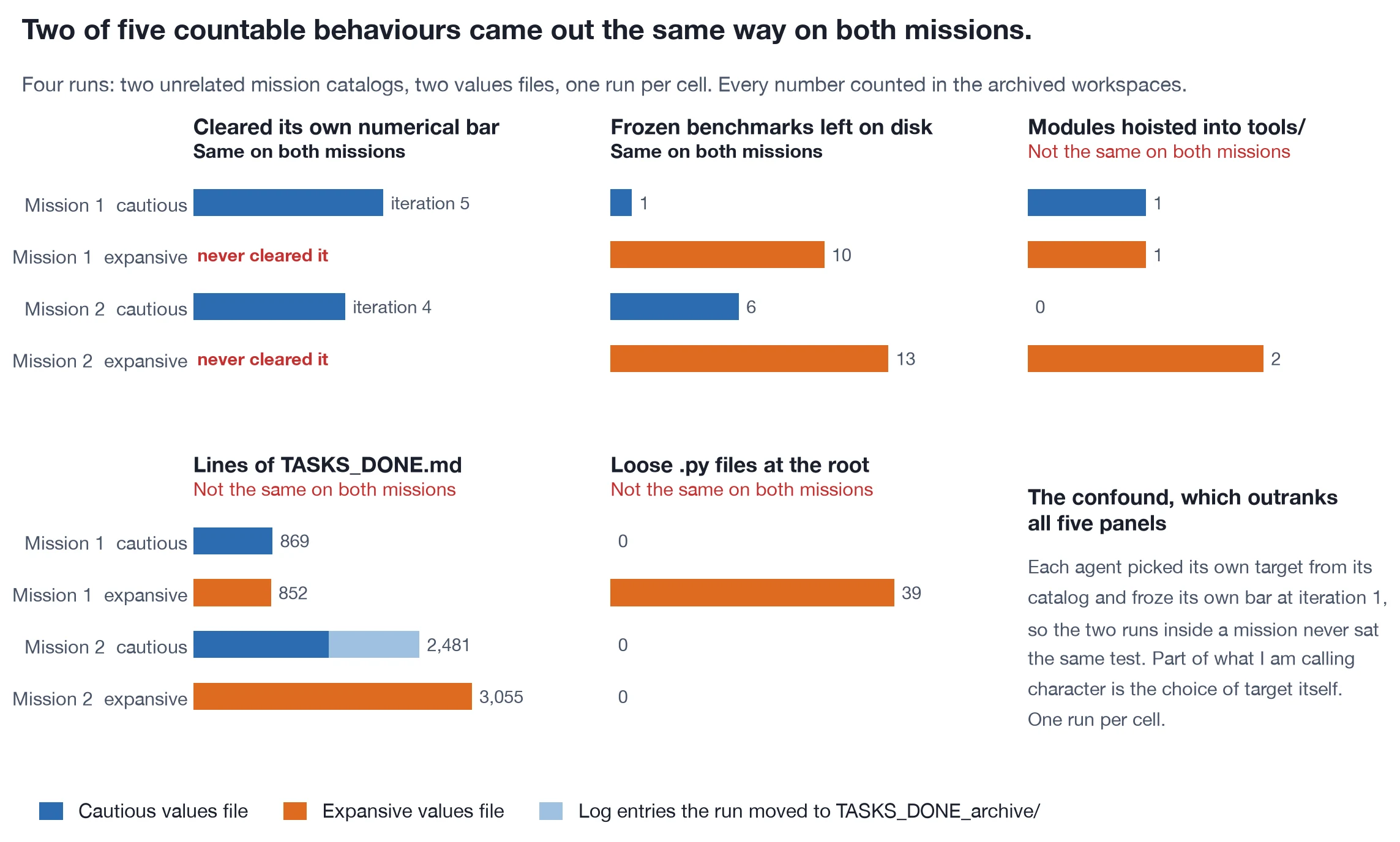
Two things came out the same way on both missions: which run cleared its own bar, and the expansive run leaving more frozen benchmarks behind, 10 against 1 on mission 1 and 13 against 6 on mission 2. Neither expansive run lowered the bar it missed, the failure the frozen-grader machinery exists to catch.
Three did not, cautious first. Hoisted shared modules were 1 against 1 on mission 1 and 0 against 2 on mission 2. Loose scripts at the workspace root were 0 against 39 on mission 1, the biggest measured difference in the experiment, and 0 against 0 on mission 2, because three hours before mission 2 started I committed a runner change restoring a workspace-layout sweep at the review checkpoint, precisely because of that 39. The gap I would most like to call character is one I closed myself between the missions.
The third is a number I got wrong. I reported log length on mission 2 as 1,487
lines against 3,055, which is not like for like: the mission-2 cautious run is
the only one that archived old entries, moving its first fifteen iterations into
TASKS_DONE_archive/, another 994 lines. Counted properly it is 2,481 against
3,055. My own deck names that archive in the same bullet as the 1,487; I quoted
the number without the caveat next to it. On mission 1 the logs are 869 and 852,
a tie.
What I cannot settle
The confound is the whole problem. The two agents inside a mission never worked on the same problem: each picked its own target and wrote its own bar, so “cleared the bar” compares two different tests sat by two different students, and part of what I am calling character is the choice of target itself.
It eats into the benchmark count too: the audit reads a run’s extra benchmark directories as harder rungs of the problem it happened to pick rather than a wider reach, which is close to saying the count belongs to the target and not to the values. I do not think that fully explains 10 against 1 and 13 against 6, but I cannot show it does not.
Nor can I rescue the audit’s verdict wholesale. It is right that mission 2 is the cleanest pair and the residue thin. But one of its two data points there was reclassified nine days later, its own claim table grades that claim PARTIAL at medium confidence, the weakest grade of anything it kept, and its headline is flagged as over-generalised. The document that disagrees with my replication is not in good enough shape to replace it. My filing is a verdict too: both of these documents sit in an archive folder, and on the day the corrections landed I promoted the sixty-iteration study out of it.
So: one run per cell, two missions, a target-choice confound, and three rounds of my own writing that do not agree. The most recent verifies numbers rather than adjudicating readings; it neither restores the replication nor endorses the audit. What would settle it is more than one run per cell, iterations and configuration held equal, and a fixed starting target so that target choice cannot masquerade as character. I have not run that. When I ran a properly powered version of a related question, the effect I liked went away, and on a third task, taking my own tally apart pair by pair left no reliable direction at all. Neither of those is this experiment; I have not settled this one.
Where my records disagree
“Completed” is doing more work than it should here, as it was in my write-up of the earlier pair, which reported “60 of 60 completed” when it meant the highest iteration reached. No iteration in these four was killed by its own time cap, but only mission 2’s expansive run went start to finish in one session with a clean exit on all 40 iterations: both mission-1 runs were resumed repeatedly through API outages, and mission 2’s cautious run lost iterations 25 and 26 to overload errors and never retried them, which I have not found recorded before now and which my deck contradicts by saying both mission-2 runs completed 40 of 40.
The deck disagrees with the record in three places: mission 1 commit counts of 85 and 88 against the write-up’s 88 and 88, neither checkable now the per-run git directories are gone; a copy-pasted benchmark description on one mission-2 slide; and 92.2%, the held-out figure, given on another slide as the scored number, which is really 93.5% of the same ceiling. None of that moves the shape, and I would rather say it than have someone else find it.