A coding benchmark specifies a target, but leaves many decisions open. An agent can refine an existing algorithm, replace it, explore several approaches, or stop once a solution seems adequate. Those choices can accumulate when each coding session inherits the previous session’s work.
Values Shape What Self-Improving Coding Agents Build, by Jason Liang, Dylan Waldner, and Risto Miikkulainen, tests whether short, persistent value statements steer that process. Across six tasks, changing the statement changed both performance and the programs produced. The strongest recurring contrast was between instructions encouraging transformation and instructions favoring small, verified steps.
What changes during self-improvement
The agent improves a solver: a program that handles the benchmark task. Each run contains 15 fresh coding sessions, each lasting up to 30 minutes. A session reads the instructions and earlier notes, chooses a change, implements and tests it, records the result, and commits its work. Only committed files survive into the next session; conversational memory does not.
The main experiment keeps the Claude Opus 5 model, harness, task package, starting solver, and safety rules fixed. Values are restored at every session. The agent can rewrite solver code and tools, but cannot redefine the benchmark or scoring rules. A separate scorer evaluates saved solvers after the run using held-out data kept outside the agent’s workspace.
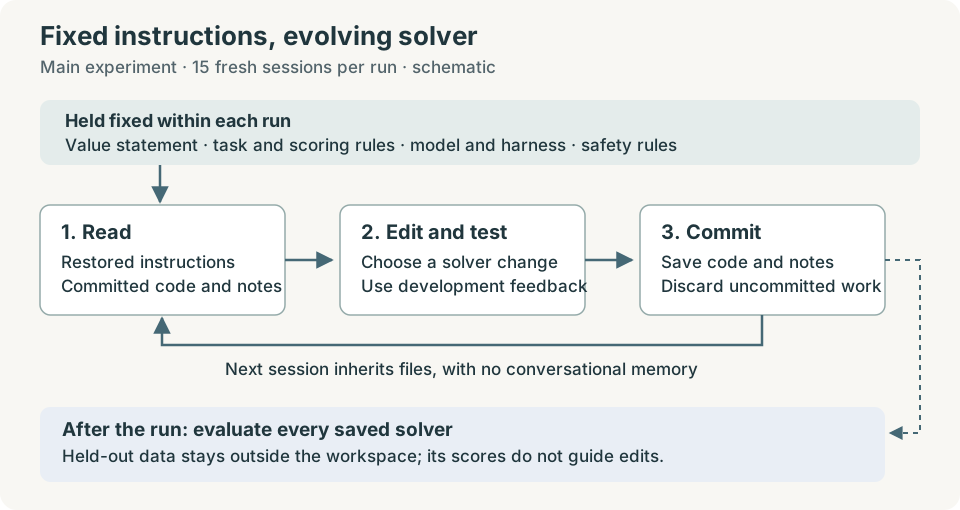
Four statements adapt the higher-order categories in Schwartz’s theory of human values. Openness favors new representations, algorithms, and continuing transformation. Conservation favors proven methods, minimal changes, and settled solutions. Self-enhancement emphasizes demonstrable achievement against an external benchmark. Self-transcendence emphasizes usefulness to others, understandable artifacts, and restraint in resource use.
The statements have similar lengths and formats. Two controls use either a short statement assigning no inherent values or similarly sized off-task text about sensory preferences. Each of the six conditions has ten independent runs on each task.
| Task | Solver objective and held-out test |
|---|---|
| ALE-Bench, AHC039 | Optimize a constrained polygon; test on 150 private cases. |
| Circle Packing | Maximize summed circle radii; transfer from visible odd sizes to 38 unseen even sizes. |
| Entity Matching | Identify matching product records; test on previously unseen product entities. |
| Game 2048 | Maximize merged-tile score; test on 30 fresh game seeds. |
| Symbolic Regression | Discover mathematical expressions; test inputs outside the training range on 129 known problems. |
| SZ-Tetris | Clear rows using only S and Z pieces; test on 100 fresh game seeds. |
Results: performance and solver design
Openness has the highest final mean on five tasks; self-enhancement leads on 2048. Pooling scores after standardizing within each task, openness outperforms the no-values control, while conservation and self-transcendence score below it. The clearest opposing pair is openness versus conservation.
Openness’s individual advantages over the no-values control reach statistical significance on ALE-Bench and Circle Packing, rather than all six tasks. No value statement differs significantly from that control on Symbolic Regression.
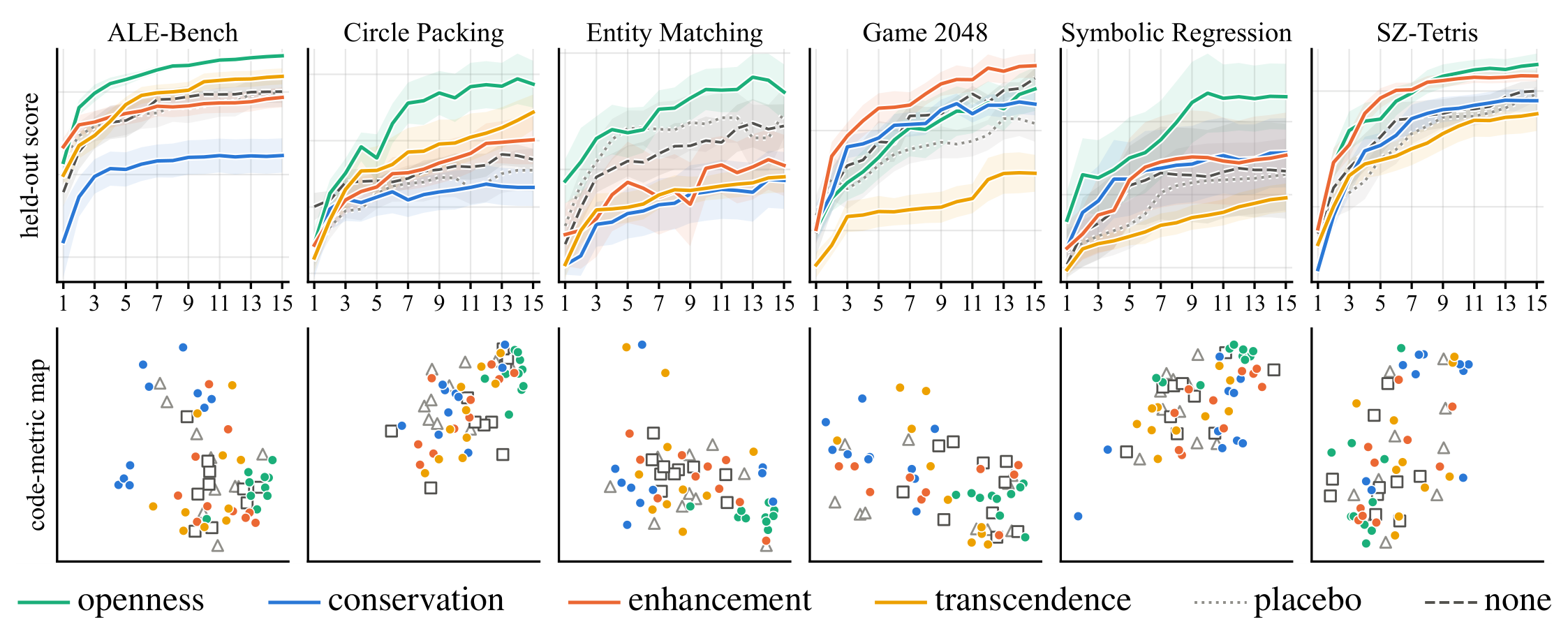
Every openness run on ALE-Bench uses general free-cell or graph-cut search, allowing a broader range of polygon shapes. Every conservation run retains column-based search. Circle Packing solvers often share a local optimizer, but openness runs more often add methods for generating and recombining candidate packings.
Openness also produces larger, more complex solvers on average than the no-values control on every task. Across tasks, code size and complexity track performance more closely than evaluation count, API cost, or elapsed time. These correlations do not establish that adding code causes better performance.
A closer look at 2048
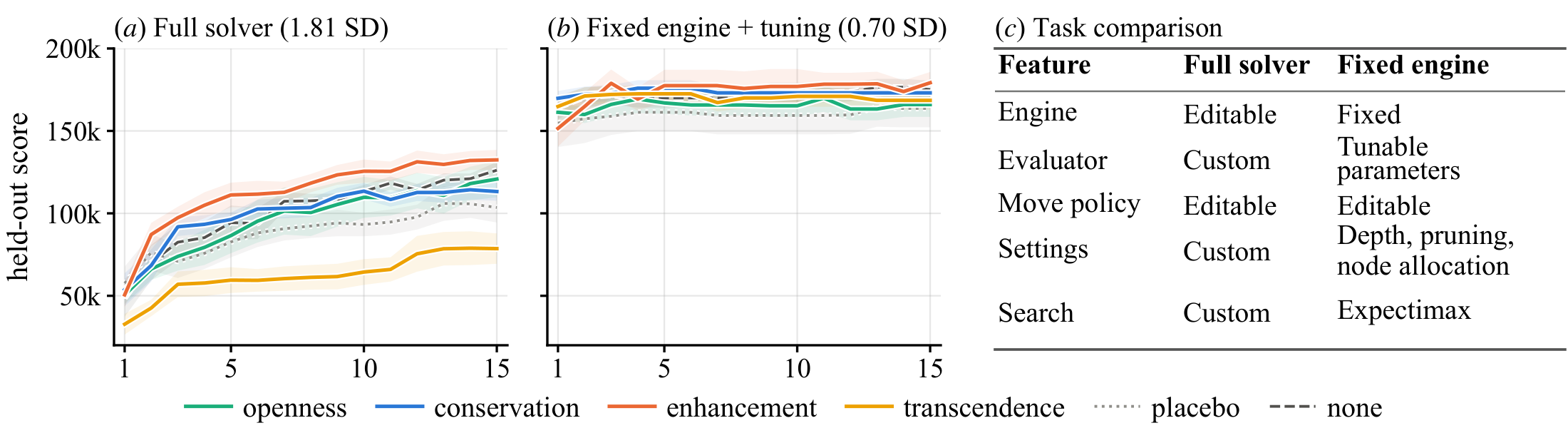
In a separate 2048 experiment, value conditions finish closer together when agents tune a supplied engine than when they can rewrite the whole solver. The versions use different compute limits, so the result suggests a role for freedom to choose algorithms without isolating its effect.
Editing values is a separate experiment
An ALE-Bench extension lets the agent revise its values between sessions while retaining fixed safety rules. The range of final condition means shrinks to about one-third of the fixed-values range: openness declines and conservation improves. Revised statements become longer and more task-specific in a preliminary reading; their transfer to other tasks was not tested.
Another extension derives values from selected AI research papers. Neither derived statement provides a detectable improvement on ALE-Bench or 2048. Ten runs per condition leave smaller effects unresolved.
The findings concern particular instruction texts, models, tasks, and budgets. Rewording statements changes results, and the openness–conservation gap disappears on the weakest tested model. Numerous statistical comparisons use unadjusted significance thresholds. Higher benchmark scores also establish neither ethical superiority nor agent safety. Persistent guidance can influence which solutions a coding agent develops, so its wording deserves evaluation alongside the task and scoring function.