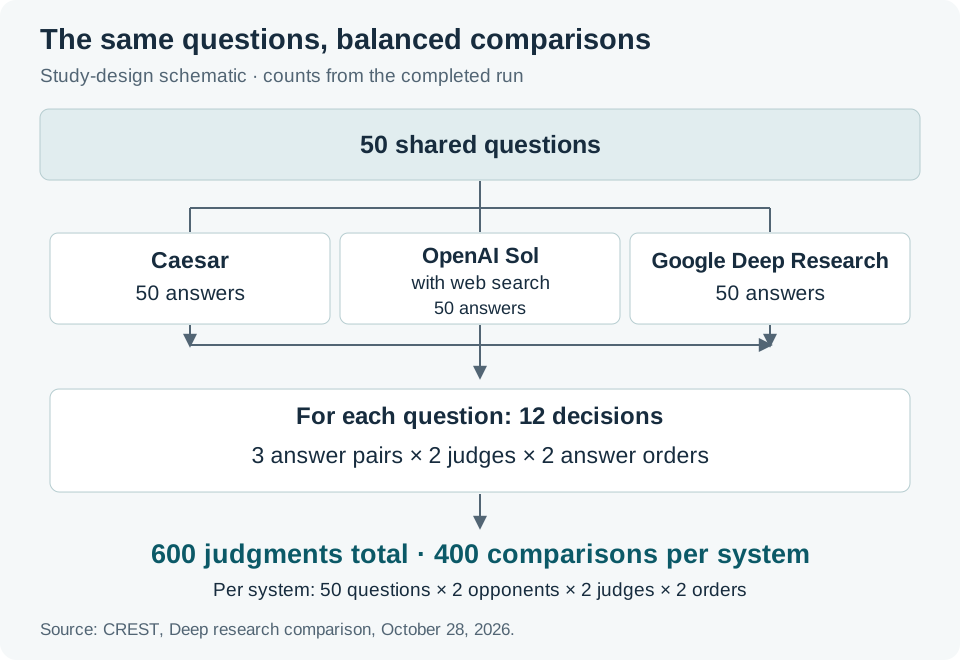
CREST (Creativity of Research Agents) asks how three research workflows respond to the same creative tasks in its deep-research comparison. Its 50 questions produced 150 saved answers, followed by 600 pairwise judgments from two AI judges. Caesar received the strongest preference, followed by OpenAI’s Sol workflow with web search and Google Deep Research.
The result concerns the creative quality those judges perceived in those answers. It does not establish that human readers or domain experts would agree, or that the answers’ factual claims are correct. The report preserves every question, answer, comparative explanation, and recorded configuration, so each preference can be inspected.
Three workflows, shared questions
The questions demand concrete artifacts under unusual constraints. Examples include a zero-electricity cooling system using materials available in 14th-century Mali, a story whose sentences alternate positive and negative sentiment, and a tabletop combat system that resolves actions through dice positions without arithmetic. These tasks require invention together with attention to the requested constraints.
Caesar combines Sol for research answers with Luna for exploration and its knowledge base. The OpenAI workflow uses Sol with web search. Google uses its managed Deep Research service.
These are comparisons of complete workflows. Their research processes and resource use differ, so the results do not isolate a single model capability or the effect of one architectural change.
One creative preference per comparison
NUS means New, Useful, and Surprising: the original contribution, its fit and support, and its departure from an expected approach. These qualities guide one joint A/B choice with a comparative explanation. They do not receive separate scores or equal votes. That lets a judge weigh a serious weakness in usefulness against a modest advantage in novelty, although the tradeoff remains the judge’s judgment.
GPT-6 Astra and Gemini 4 Argon judged each pair in both orders. Neither judge used tools. Provider names were hidden, although writing style could still reveal a system’s identity.
Each question yields three pairs × two judges × two orders: 12 decisions. Each system participates in eight, giving 400 comparisons per system across the 50 questions. Wins divided by 400 determine its overall rate.
The observed ranking
Caesar won 390 of 400 comparisons (97.5%), the OpenAI workflow won 176 (44.0%), and Google Deep Research won 34 (8.5%). In direct matchups, Caesar beat OpenAI in 96.0% of 200 decisions and Google in 99.0%; OpenAI beat Google in 84.0%.
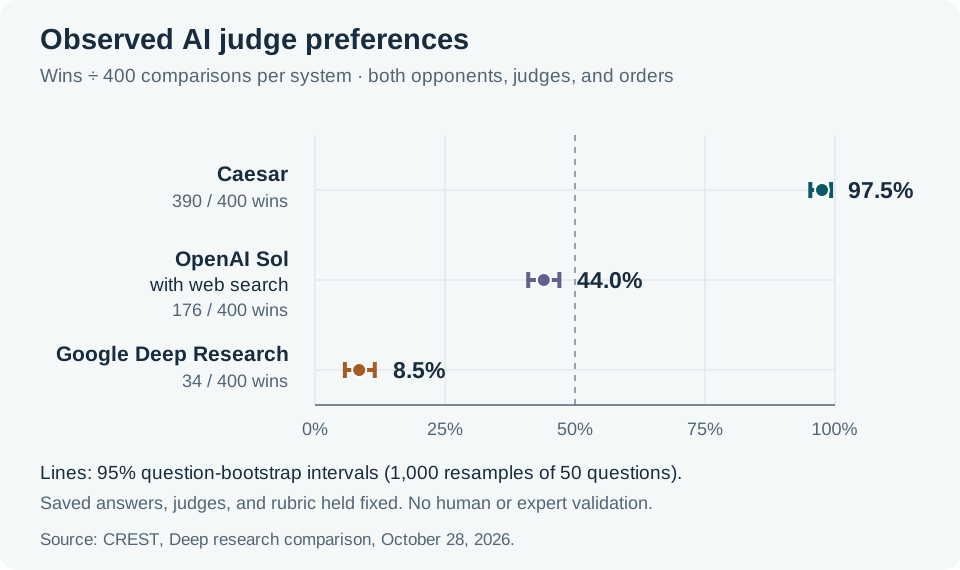
Both judges ranked Caesar first, but their other preferences differed. Astra gave OpenAI a 52.0% overall win rate and Google 0.0%; Argon gave them 36.0% and 17.0%. The judges disagreed on 40 of 300 matched presentations (13.3%). A balanced panel still leaves the ranking dependent on its judges.
The intervals come from 1,000 resamples of the 50 questions, keeping all 12 decisions for each sampled question together. This preserves the dependence among judgments about the same answers. The ranges describe sensitivity to the observed question mix while holding the saved answers, judges, and rubric fixed. They exclude variation from generating new answers, choosing other judges, and uncertainty about whether the rubric captures creativity well.
Testing how far Caesar’s lead extends requires additional tasks, repeated generations, independent factual checks, and comparison with human or domain-expert judgments.