AI scientist systems release papers on different questions, using different methods and resources. CREST (Creativity of Research Agents) examines the manuscripts available from five systems in its released-paper comparison and asks two language models to choose between sampled pairs. Sakana Agentic Scientist (v3) leads the observed ranking, with a crucial qualification: its eligible collection contains only two papers.
The comparison covers Sakana’s AI Scientist v1, v2, and Agentic Scientist v3, alongside ScientistOne and ScientistTwo. It evaluates their released paper collections. Differences in research topics, release dates, underlying models, computing resources, and publication choices remain part of the comparison. The resulting preferences cannot isolate which system design caused a difference in paper quality.
From released papers to comparisons
The archive contains 411 downloaded papers, of which 410 are eligible for the primary comparison. One manuscript involving substantial human guidance and revision is excluded. Among the eligible papers, 86 appear in the sampled comparisons. Here, 86 is the number of distinct selected papers, rather than the number of pairs or judgments.
The plan covers all ten matchups between the five systems, sampling up to ten distinct paper pairs uniformly within each matchup. The v3–v2 matchup has only six possible pairs, because those collections contain two and three eligible papers. All six are included. Together, the matchups produce 96 paper pairs. Some papers appear repeatedly against different opponents.
Two judges, Gemini 4 Argon and GPT-6 Astra, each read every pair in both paper orders. Each completed pair therefore contributes four overall choices, giving 384 saved judgments. Reversing the order helps expose sensitivity to which manuscript appears first. It does not create another independent paper.
One overall judgment
The judges consider New, Useful, and Surprising jointly, then choose one manuscript and explain the tradeoffs. New concerns how specifically the judge can place the contribution in earlier work; Useful concerns the mechanism and evidence supporting the claimed benefit; Surprising concerns departure from the obvious approach to the paper’s own question. These considerations guide a single choice, without separate numerical scores for each quality.
The judges receive extracted PDF text. Their explanations can be inspected against the manuscripts, but the procedure does not independently reproduce experiments or inspect visual plots. A model’s inability to recall prior work also cannot establish historical novelty. Human-expert agreement and the validity of this particular creativity instrument remain untested.
The observed ranking
The score first averages the four choices within a paper pair, then averages pairs within each matchup. Finally, it gives each of the four opponents equal weight. Thus the six-pair v3–v2 matchup has the same weight in a system’s overall score as a ten-pair matchup. A much larger released collection does not receive extra weight simply because it contains more papers.
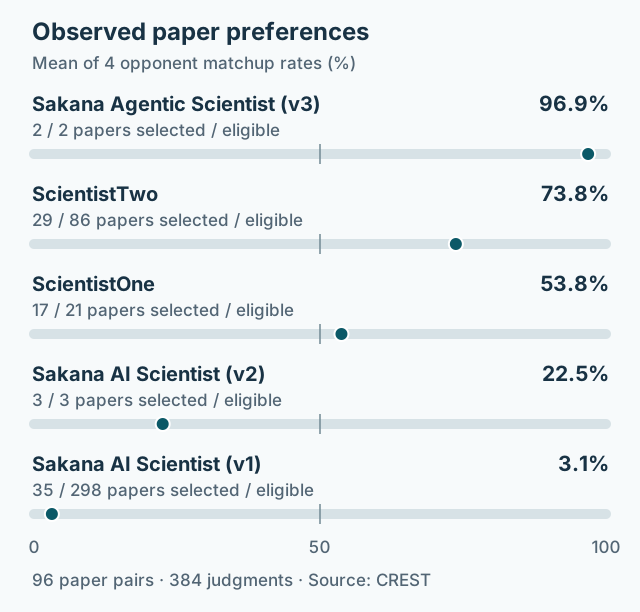
Sakana Agentic Scientist (v3) receives a 96.9% overall preference rate, followed by ScientistTwo at 73.8%, ScientistOne at 53.8%, Sakana AI Scientist v2 at 22.5%, and v1 at 3.1%. For example, v3 receives 87.5% of the choices against ScientistTwo and 100% against each other opponent. Its overall score is the equal-weight average of those four matchup rates.
The small collections constrain that result. Every eligible v3 and v2 paper is selected, but repeatedly comparing two or three manuscripts supplies little evidence about the range of papers those systems might produce in future. For the larger pools, substantial portions of the released work remain unsampled.
The cohort expanded from four to five systems after earlier results had been observed, and the sample also grew after initial results. The report’s exploratory sampling ranges use a nominal 95% fixed-size calculation, with no 95% coverage guarantee for this extension. They condition on the frozen paper pools and judge/order outcomes; they exclude model variability, judge validity, and future work. The ranking across every eligible paper pair therefore remains uncertain.
The public evidence report supplies selected PDFs, release records, head-to-head rates, and saved comparative explanations. Those records allow individual choices to be examined and disputed. The observed ordering applies to these released papers, opponents, and judging procedure.